Short Answer
The cost of pallet racking is usually calculated based on cost per pallet position rather than total system price.
Depending on the racking type, warehouse height, and load capacity, pallet racking systems typically range from $50 to $200 per pallet position.
This pricing approach helps warehouse planners estimate storage system investment more accurately.
Why Pallet Racking Cost Is Often Calculated Per Pallet Position
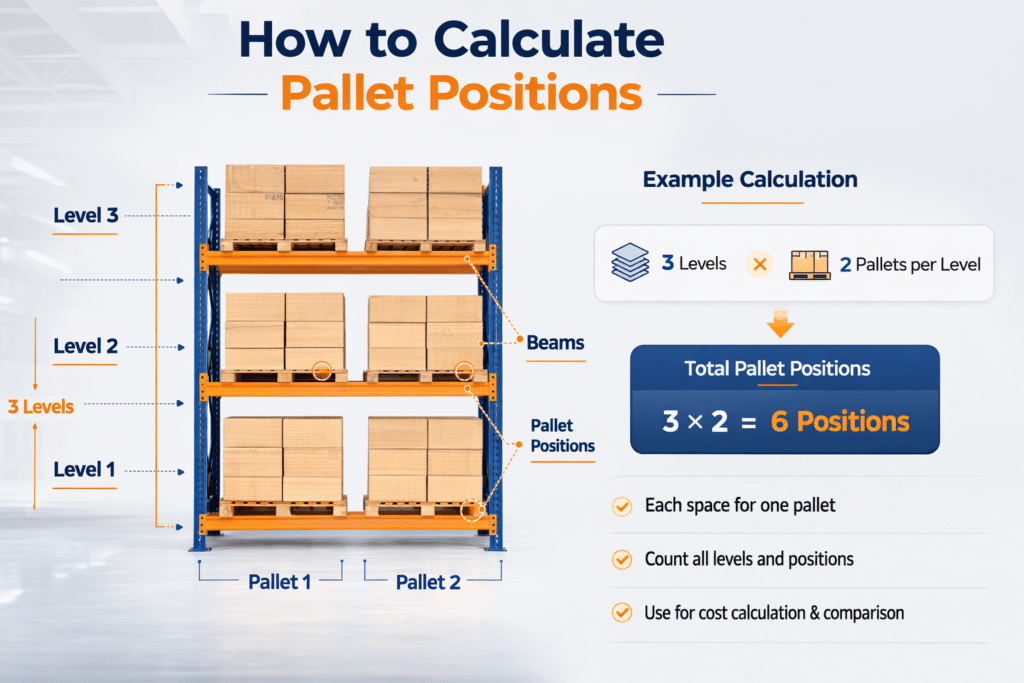
When evaluating warehouse storage systems, engineers and planners usually calculate investment using cost per pallet position.
A pallet position refers to one pallet storage space inside the racking system.
For example:
- A rack bay with 3 levels
- Each level storing 2 pallets
Total pallet positions:
3 × 2 = 6 pallet positions
Using cost per pallet position allows warehouse planners to compare different racking systems more easily.
Average Pallet Racking Cost Per Pallet Position
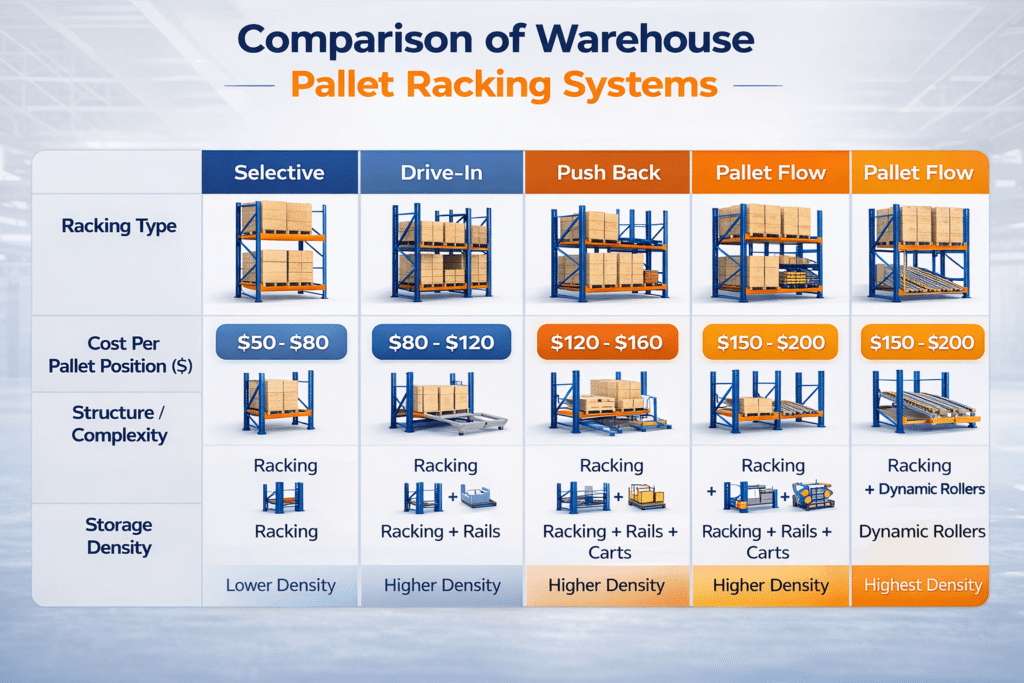
Below is a general industry estimate.
| Racking Type | Typical Cost Per Pallet Position |
|---|---|
| Selective pallet racking | $50 – $80 |
| Drive-in racking | $80 – $120 |
| Push-back racking | $120 – $160 |
| Pallet flow racking | $150 – $200 |
| Mezzanine racking | $200+ |
Higher-density systems usually have a higher cost per pallet position because they include additional structural components.
Factors That Influence Pallet Racking Cost
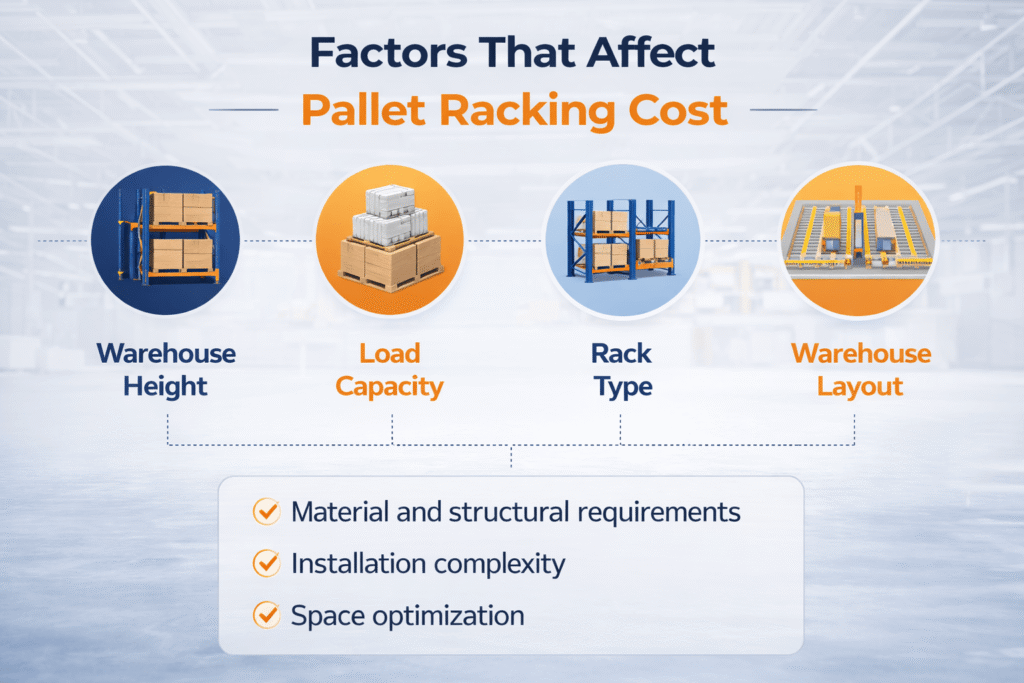
Several technical factors affect the final cost of pallet racking.
1. Warehouse Height
Higher warehouses require:
- Taller uprights
- Stronger beams
- Additional structural reinforcement
This increases both material and installation costs.
2. Load Capacity
Heavy-duty pallet loads require:
- Thicker steel sections
- Reinforced beams
- Stronger connectors
Higher load capacity generally results in higher system cost.
3. Storage Density
Different racking systems provide different storage densities.
Examples:
- Selective racking → lower density
- Drive-in racking → higher density
- Push-back racking → high density with better accessibility
Higher-density systems often reduce aisle space but increase structural complexity.
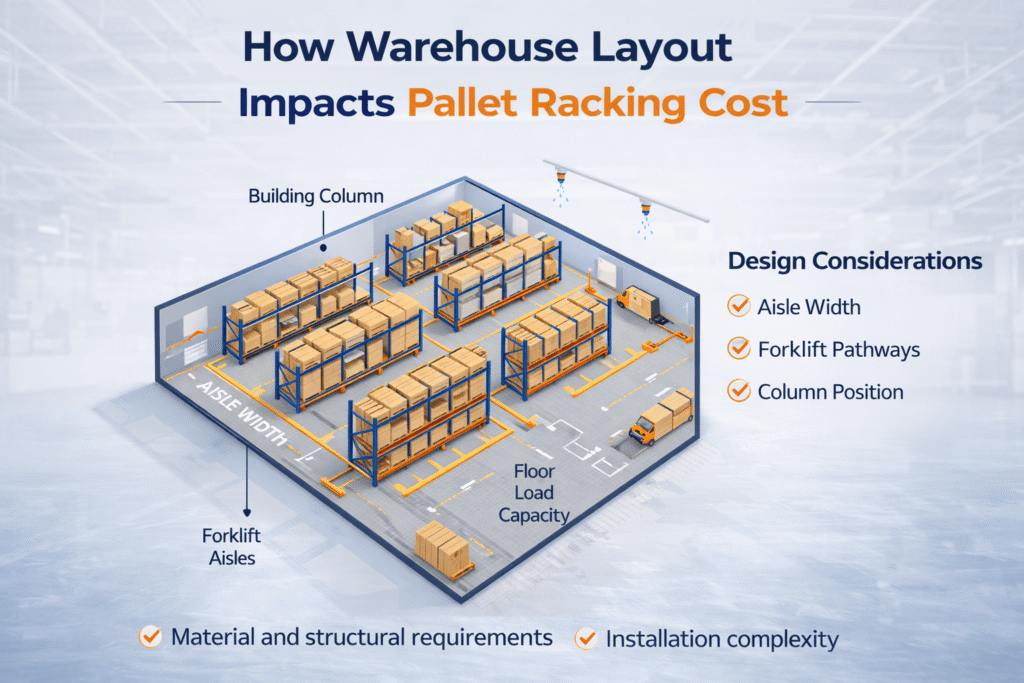
4. Warehouse Layout
The total cost is also influenced by:
- Building column spacing
- Floor load capacity
- Fire protection systems
- Forklift aisle width
Efficient layout planning can significantly improve cost efficiency.
Cost Comparison: Selective vs High-Density Racking
Selective pallet racking is typically the lowest-cost option, but it requires more aisle space.
High-density systems such as push-back or pallet flow racks reduce aisle requirements and increase storage capacity, but they involve additional components such as rails, carts, or rollers.
This means the initial investment is higher, but the cost per stored pallet may be lower in high-density warehouses.
How Warehouse Design Impacts Storage Investment
In many warehouse projects, the racking system itself represents 30–40% of the total warehouse investment.
Other factors include:
- forklifts
- warehouse floor preparation
- fire protection systems
- lighting and safety equipment
Proper system selection helps ensure that storage investment matches operational needs.
Estimating Pallet Racking Budget
Before installing a pallet racking system, warehouse planners typically evaluate:
- pallet dimensions
- load weight
- warehouse height
- SKU variety
- required storage density
These parameters help determine the most suitable racking configuration.
For a detailed overview of pallet racking pricing, you can read our guide on
👉 pallet racking system costs
https://www.djstoragerack.com/how-much-does-pallet-racking-cost/
Conclusion
Pallet racking cost varies depending on system design, load requirements, and warehouse layout.
Using cost per pallet position provides a practical way to compare storage solutions and estimate warehouse investment.
Understanding these cost factors helps businesses choose the right racking system for both operational efficiency and long-term storage performance.