Short Answer
Pallet racking cost is influenced by several key factors, including warehouse height, load capacity, racking type, storage density, and layout design.
Understanding these factors helps businesses estimate storage investment more accurately and choose the right racking system.
Why Pallet Racking Cost Varies Between Projects
Pallet racking systems are not standardized products.
Each project is designed based on warehouse dimensions, load requirements, and operational workflow.
This is why two warehouses with similar sizes can have significantly different racking costs.
Key Factors That Affect Pallet Racking Cost
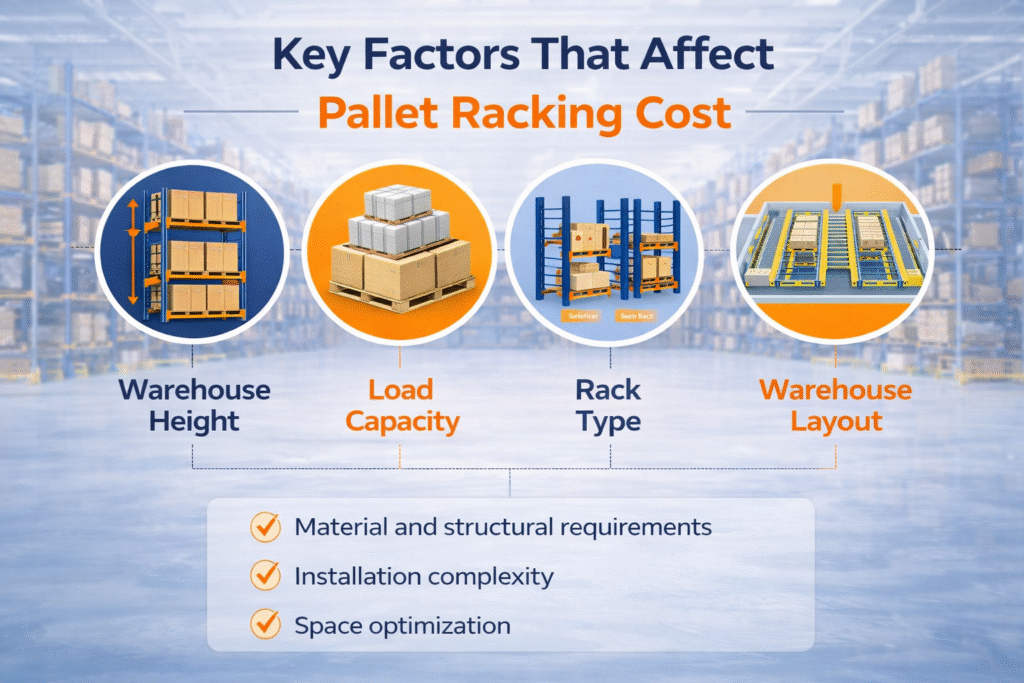
1. Warehouse Height
Warehouse height directly impacts:
- Upright column height
- Structural stability requirements
- Installation complexity
Taller systems require more steel and engineering considerations, which increases cost.
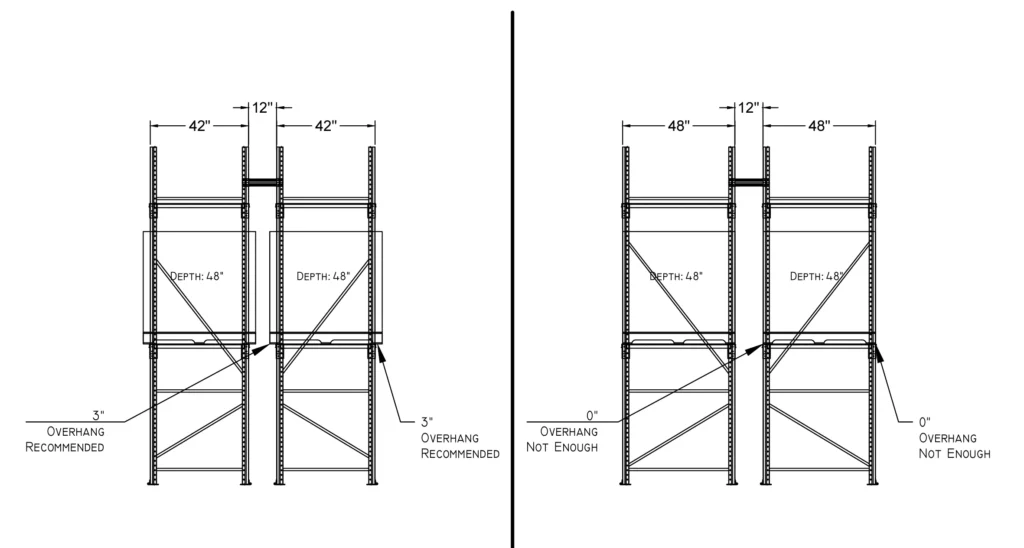
2. Load Capacity
The weight of each pallet determines:
- Beam strength
- Upright thickness
- Connector design
Heavy-duty systems require stronger materials, leading to higher costs.
3. Racking System Type
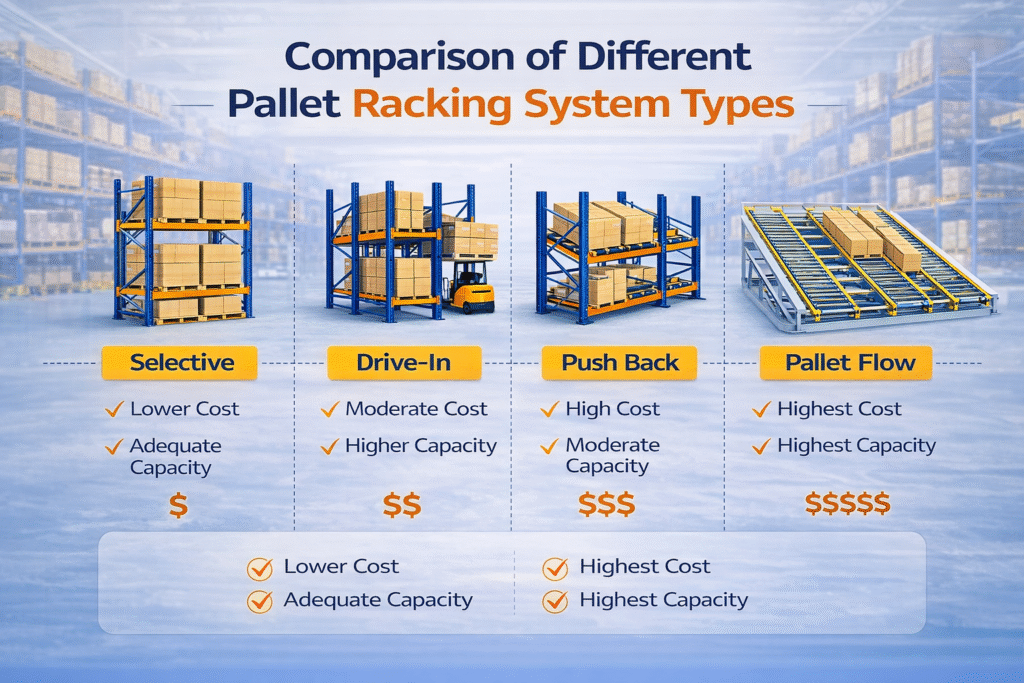
Different racking systems have different structural complexity.
Examples:
- Selective racking → simple structure, lower cost
- Drive-in racking → higher density, moderate complexity
- Push-back racking → carts and rails, higher cost
- Pallet flow racking → dynamic system, highest cost
System selection is one of the biggest cost drivers.
4. Storage Density Requirements
Higher storage density usually means:
- Reduced aisle space
- More complex system design
- Additional components
While high-density systems cost more initially, they can reduce cost per pallet position.
5. Warehouse Layout
Layout design affects:
- Aisle width
- Rack arrangement
- Column interference
- Forklift operation paths
Efficient layout planning can significantly improve space utilization and reduce unnecessary costs.
6. Floor Load Capacity
Warehouse floor conditions are often overlooked.
If the floor cannot support heavy loads:
- Reinforcement may be required
- Rack design must be adjusted
This can increase overall project cost.
Cost Trade-Off: Initial Investment vs Storage Efficiency
Lower-cost systems such as selective racking require more aisle space and provide lower storage density.
Higher-cost systems such as push-back or pallet flow racks increase storage density but involve higher structural complexity.
The optimal solution depends on balancing:
- Budget
- Storage capacity
- Operational efficiency
How to Estimate Pallet Racking Cost More Accurately
Before planning a racking system, it is important to define:
- pallet size and weight
- number of SKUs
- warehouse height
- required storage density
- handling equipment
These parameters allow for a more accurate system design and cost estimation.
For a detailed breakdown of pricing, you can also refer to:
👉 pallet racking cost guide
https://www.djstoragerack.com/how-much-does-pallet-racking-cost/
👉 cost per pallet position
https://www.djstoragerack.com/pallet-racking-cost-per-pallet-position/
Conclusion
Pallet racking cost depends on multiple technical and operational factors.
Understanding these variables helps warehouse planners choose the most efficient and cost-effective storage solution.