Short Answer
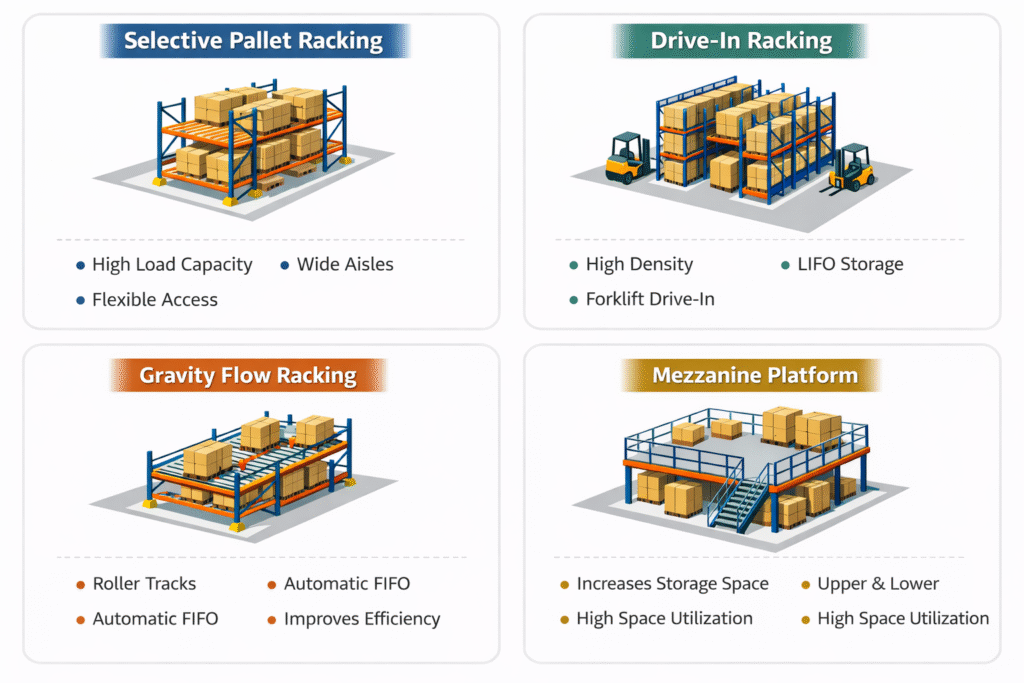
Pallet racking systems are used to store palletized goods efficiently in warehouses.
The main types include selective racking, drive-in racking, push-back racking, and pallet flow racking, each designed for different levels of storage density, accessibility, and inventory flow.
The best system depends on SKU variety, storage density, and inventory rotation method (FIFO or LIFO).
Quick Comparison: Pallet Racking Types at a Glance
| Racking Type | Density | Access | Inventory Flow | Best For |
|---|---|---|---|---|
| Selective | Low | Direct | FIFO | High SKU |
| Drive-in | High | Limited | LIFO | Bulk storage |
| Push-back | High | Moderate | LIFO | Medium SKU |
| Pallet flow | Very high | Controlled | FIFO | Fast turnover |
👉 This table helps quickly identify the most suitable system before going into details.
What Are Pallet Racking Systems?
Pallet racking systems are industrial steel storage structures designed to store goods on pallets in vertical rows.
They are used to:
- maximize warehouse space
- organize inventory efficiently
- improve forklift handling operations
Different systems are used depending on operational priorities such as density, accessibility, and throughput.
Main Types of Pallet Racking Systems
1. Selective Pallet Racking
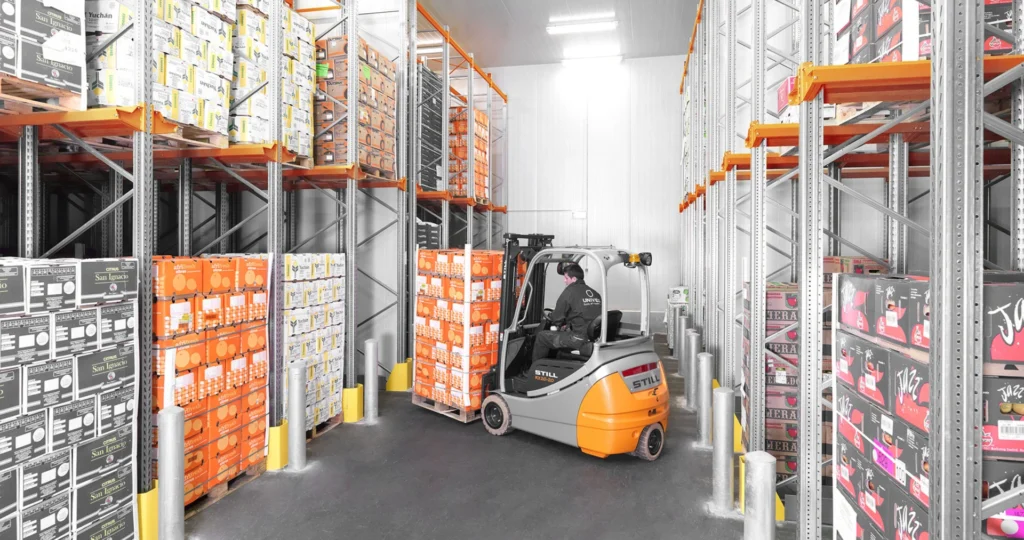
Selective racking is the most widely used system due to its flexibility.
Key features:
- direct access to every pallet
- simple and cost-effective structure
- compatible with most forklifts
When to use:
- high SKU variety
- frequent inventory changes
- flexible storage requirements
2. Drive-In Pallet Racking
Drive-in racking is designed for high-density storage by reducing aisle space.
Key features:
- forklifts enter the rack system
- deep lane storage
- LIFO (Last-In, First-Out)
When to use:
- large quantities of the same product
- cold storage warehouses
- limited warehouse space
3. Push-Back Pallet Racking
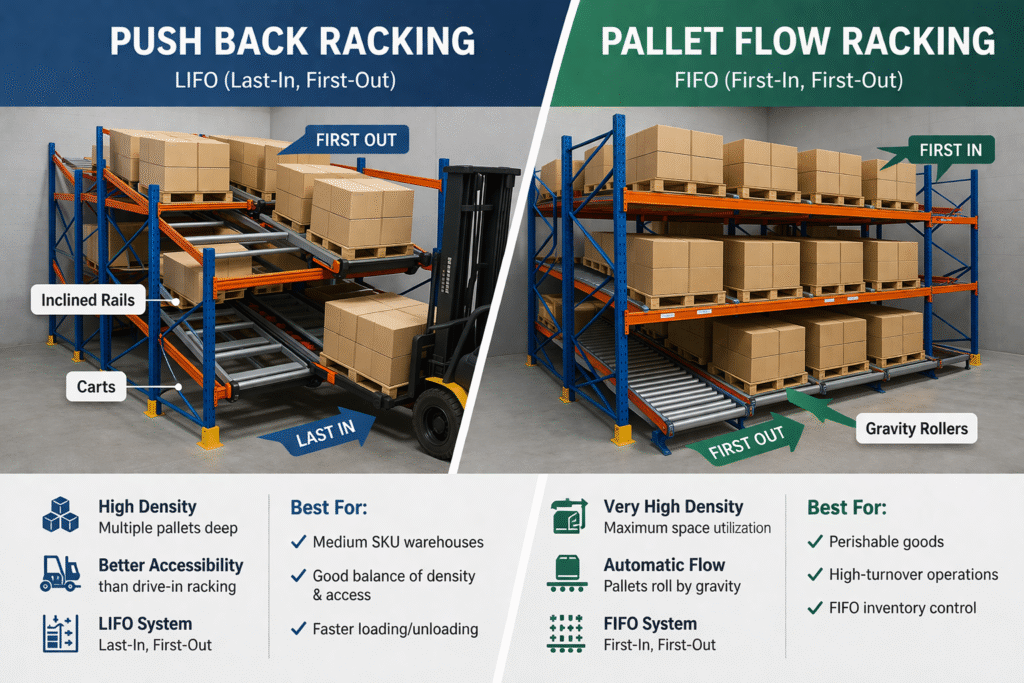
Push-back racking improves storage density while maintaining better accessibility than drive-in systems.
Key features:
- gravity-assisted carts
- multiple pallet positions per lane
- LIFO system
When to use:
- medium SKU environments
- need for both density and efficiency
4. Pallet Flow Racking
Pallet flow racking is a high-density system designed for FIFO inventory flow.
Key features:
- gravity roller system
- automatic pallet movement
- high throughput
When to use:
- perishable goods
- time-sensitive inventory
- high turnover operations
How to Choose the Right Pallet Racking System
Choosing the correct system is not about picking the most advanced option, but the one that fits your warehouse conditions.
1. SKU Variety
- High SKU → Selective racking
- Low SKU → High-density systems
2. Storage Density
- Space limitation → Drive-in / Push-back
- Flexible layout → Selective
3. Inventory Flow
- FIFO required → Pallet flow
- LIFO acceptable → Drive-in / Push-back
4. Warehouse Layout
Key factors include:
- aisle width
- forklift movement
- building columns
These directly affect system efficiency and cost.
When High-Density Racking Systems Make Sense
High-density systems are suitable when:
- warehouse space is limited
- storage volume is high
- SKU variety is low
They reduce aisle space and increase storage capacity but involve more complex design.
Cost Considerations by Racking Type
Different systems have different cost structures.
- Selective racking → lowest cost
- Drive-in → medium cost
- Push-back → higher cost
- Pallet flow → highest cost
For a detailed cost breakdown, you can read:
👉 https://www.djstoragerack.com/how-much-does-pallet-racking-cost/
👉 https://www.djstoragerack.com/pallet-racking-cost-per-pallet-position/
From System Selection to Project Planning
Understanding the different types of pallet racking is the first step in warehouse design.
The final system selection depends on:
- pallet dimensions
- load capacity
- warehouse height
- operational workflow
👉 For detailed system configurations, you can explore:
https://www.djstoragerack.com/product/pallet-racking/
Conclusion
There is no single “best” pallet racking system.
Each type is designed for a specific storage scenario.
Choosing the right system requires balancing:
- storage density
- accessibility
- cost
- operational efficiency