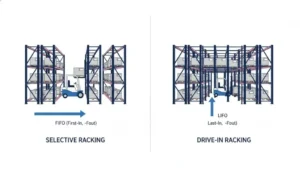
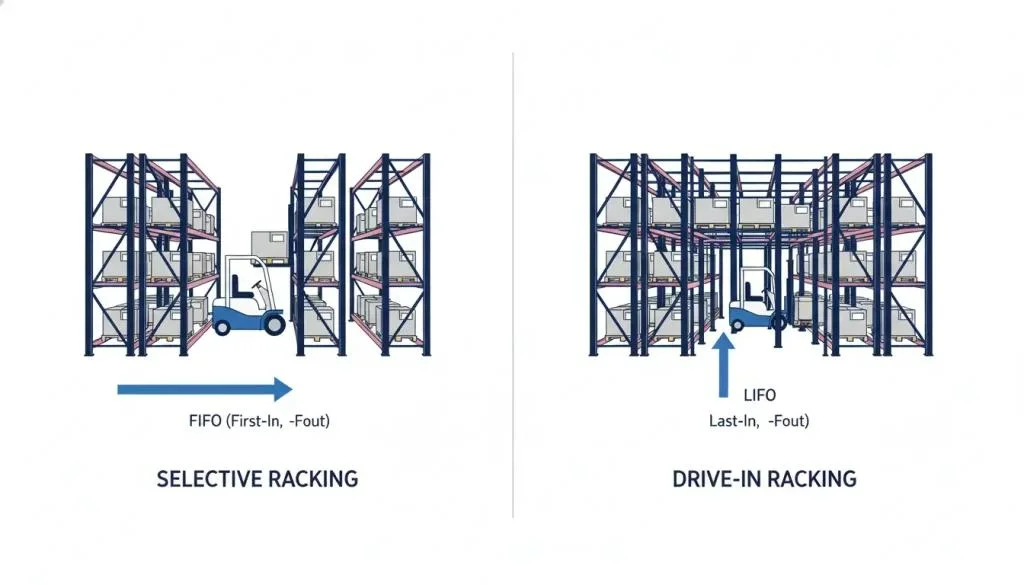
Short Answer
Selective pallet racking is best for warehouses that require direct access to every pallet and high SKU variety.
Drive-in racking is designed for maximum storage density, making it ideal for bulk storage of the same product where space optimization is critical.
Quick Comparison (Decision Table)
| Factor | Selective Racking | Drive-In Racking |
|---|---|---|
| Pallet Access | Direct | Limited |
| Storage Density | Medium | High |
| SKU Type | Multiple SKUs | Single / Low SKU |
| Aisle Space | Wide aisles required | Minimal aisles |
| Inventory Flow | FIFO | LIFO |
| Cost per Pallet Position | Higher | Lower |
| Operational Complexity | Low | Medium–High |
👉 This table is the fastest way to determine which system fits your warehouse.
What Is the Real Difference?
The difference is not just structure — it is how your warehouse operates.
Selective Racking
- Designed for access efficiency
- Every pallet is individually accessible
- Suitable for dynamic inventory environments
Drive-In Racking
- Designed for space efficiency
- Pallets are stored in deep lanes
- Forklifts enter the rack system
Real Warehouse Scenarios
This is where most competitors are weak.
Scenario 1 — E-commerce Warehouse
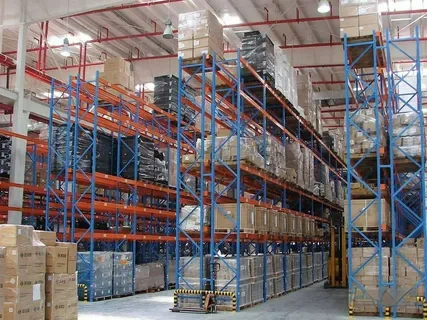
- Thousands of SKUs
- Frequent picking
- High turnover
👉 Best choice: Selective Racking
Scenario 2 — Cold Storage (Frozen Food)
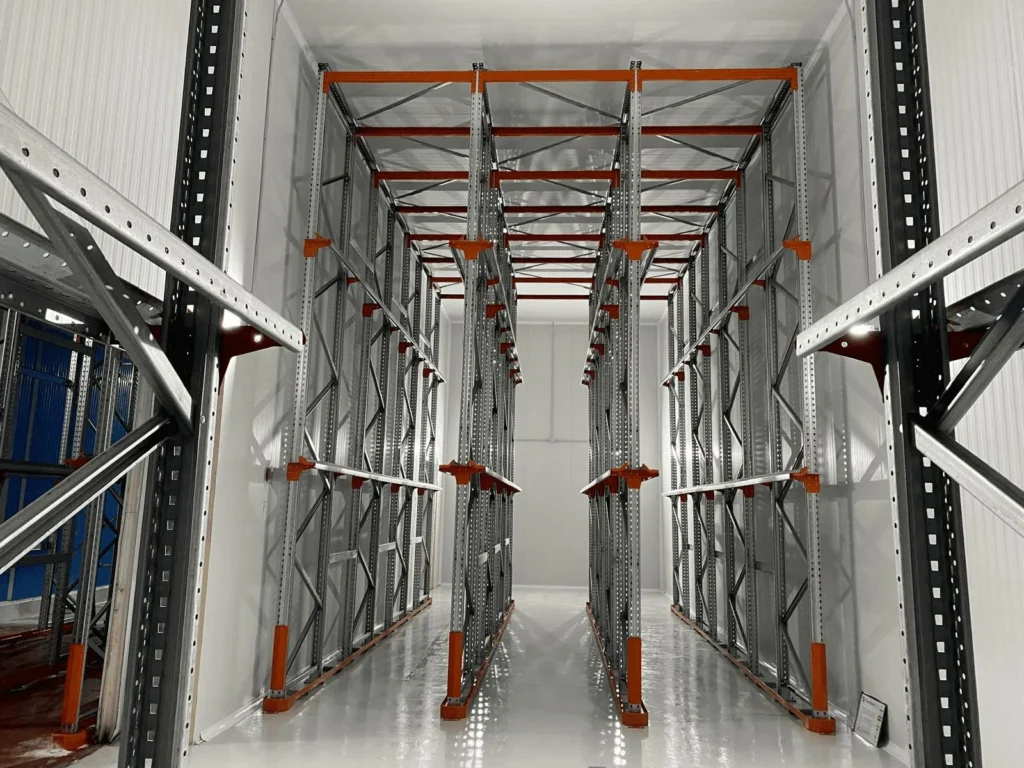
- Large quantity of the same product
- High cost per square meter
- Limited space
👉 Best choice: Drive-In Racking
Scenario 3 — Manufacturing Warehouse
- Mixed inventory
- Medium turnover
👉 Often: Hybrid solution (Selective + Drive-In)
Storage Density Comparison
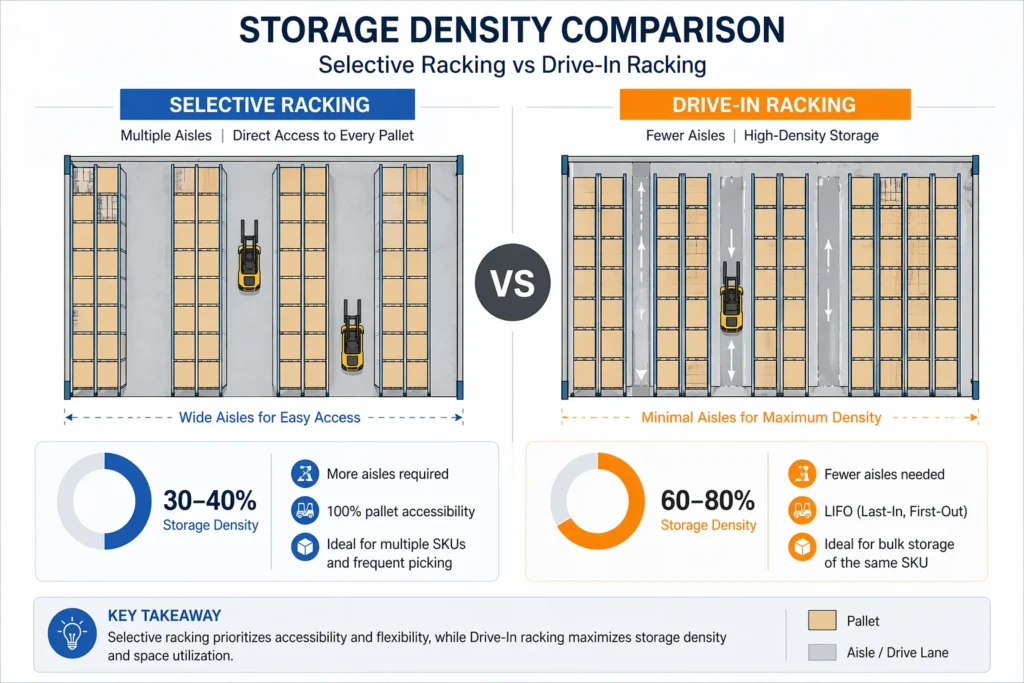
In real projects:
- Selective racking utilization: 30%–40% floor efficiency
- Drive-in racking utilization: 60%–80% floor efficiency
👉 This is why drive-in is widely used when space cost is high.
Cost Comparison (Real Logic, Not Surface Level)
Most websites only say:
drive-in cheaper ❌
But the real logic is:
Selective Racking
- Lower system complexity
- Higher space usage → higher long-term cost
Drive-In Racking
- Higher initial engineering requirement
- Lower cost per pallet position
👉 Cost must be evaluated per:
cost per pallet position
For full breakdown:
👉 /how-much-does-pallet-racking-cost/
Advantages and Limitations
Selective Racking
Advantages
- direct pallet access
- flexible layout
- easy expansion
Limitations
- lower density
- more aisle space
Drive-In Racking
Advantages
- maximum storage density
- better space utilization
- reduced warehouse footprint
Limitations
- limited access
- LIFO only
- higher forklift skill requirement
When NOT to Use Each System
This section is critical for ranking.
Avoid Selective Racking if:
- warehouse space is limited
- SKU variety is low
- density is priority
Avoid Drive-In Racking if:
- frequent picking required
- SKU diversity is high
- FIFO is necessary
Decision Framework (Very Important)
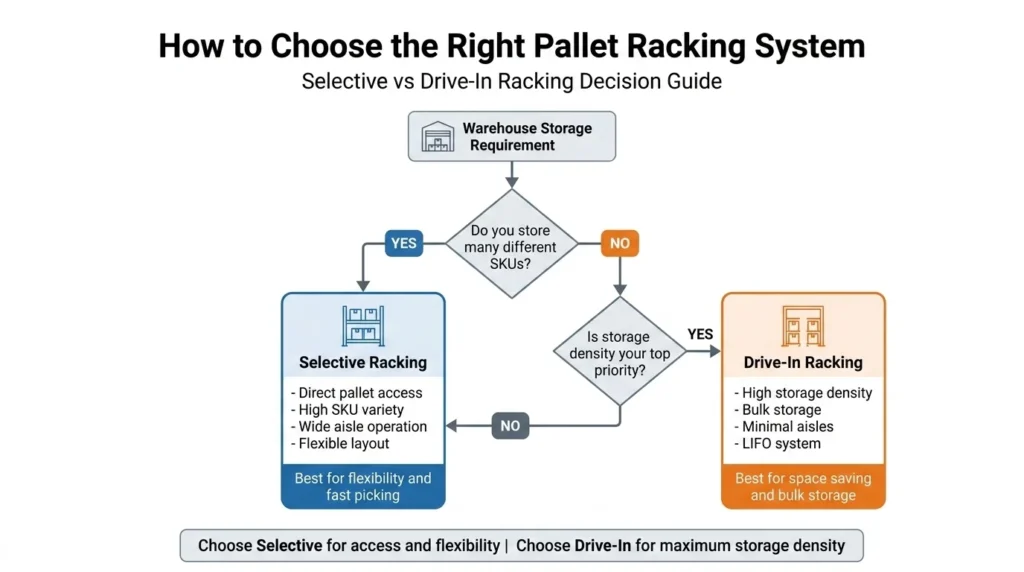
Use this logic:
If access is more important → Selective
If space is more important → Drive-In
Or more precisely:
High SKU + high turnover → Selective
Low SKU + bulk storage → Drive-In
From Selection to Real Implementation
Choosing a system is only step one.
Real warehouse projects require:
- layout planning
- load calculation
- aisle design
- safety compliance
👉 Explore full solutions:
/product/pallet-racking/
👉 Work with a manufacturer:
/pallet-racking-manufacturer/
Conclusion
Selective and drive-in racking systems are not competitors — they are solutions for different operational needs.
The right choice depends on:
- storage density
- SKU structure
- warehouse workflow