Author: DJ Storage Rack Technical Content Team
Reviewed by: DJ Storage Rack Engineering Support Team
Last Updated: July 2026
Short Answer
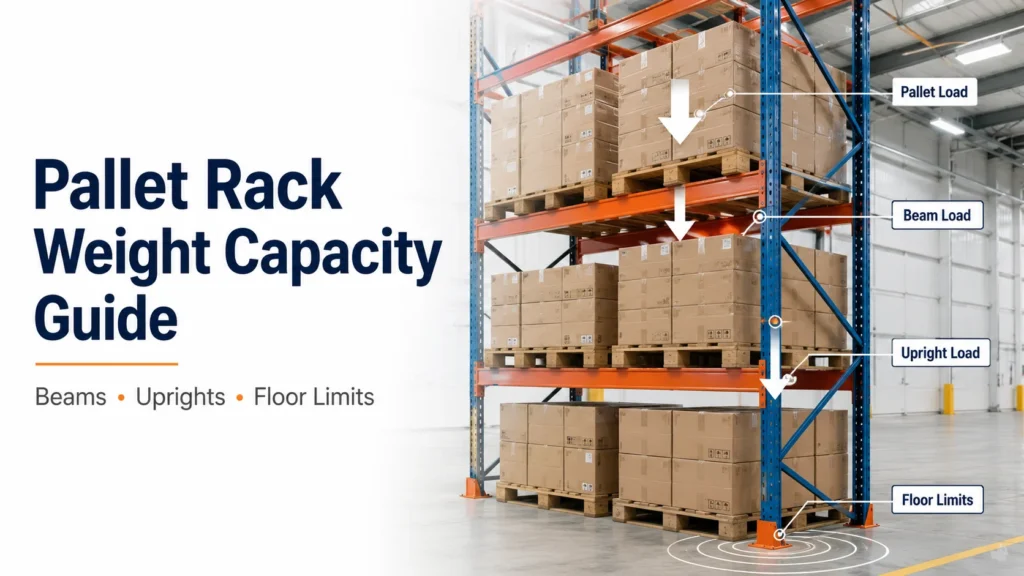
Pallet rack weight capacity is the load a rack can safely support under a specific configuration. It is mainly affected by the pallet weight, beam span, upright frame, beam-level spacing, load distribution and warehouse floor condition.
A beam capacity chart can help with early comparison, but it cannot confirm whether a rack is suitable for your project. Before production, the rack supplier should review the actual pallet load, rack layout, beam levels, forklift operation, floor condition and local project requirements.
For buyers, the key is not to ask only, “How much weight can this rack hold?” A better question is: “What rack configuration is this load rating based on?”
What Buyers Should Check First
Before comparing suppliers, check these points first:
| Buyer question | What to check first |
|---|---|
| Can this rack hold my pallet? | Maximum pallet weight and pallets per level |
| Can I use longer beams? | Beam span, beam profile and load distribution |
| Can I add one more storage level? | Upright capacity and beam-level spacing |
| Can I store heavier goods later? | Beams, uprights, anchors and floor slab |
| Why is one quote cheaper? | Steel configuration, accessories and installation scope |
| Is a capacity chart enough? | No. Use it only as an early reference |
| Can I reuse an existing rack? | Original load rating, current condition and new layout |
| Does the floor need checking? | Yes, especially for heavy loads, high racks or old buildings |
This quick check helps avoid one of the most common purchasing mistakes: comparing rack prices without comparing the design conditions behind those prices.
What Does Pallet Rack Weight Capacity Mean?
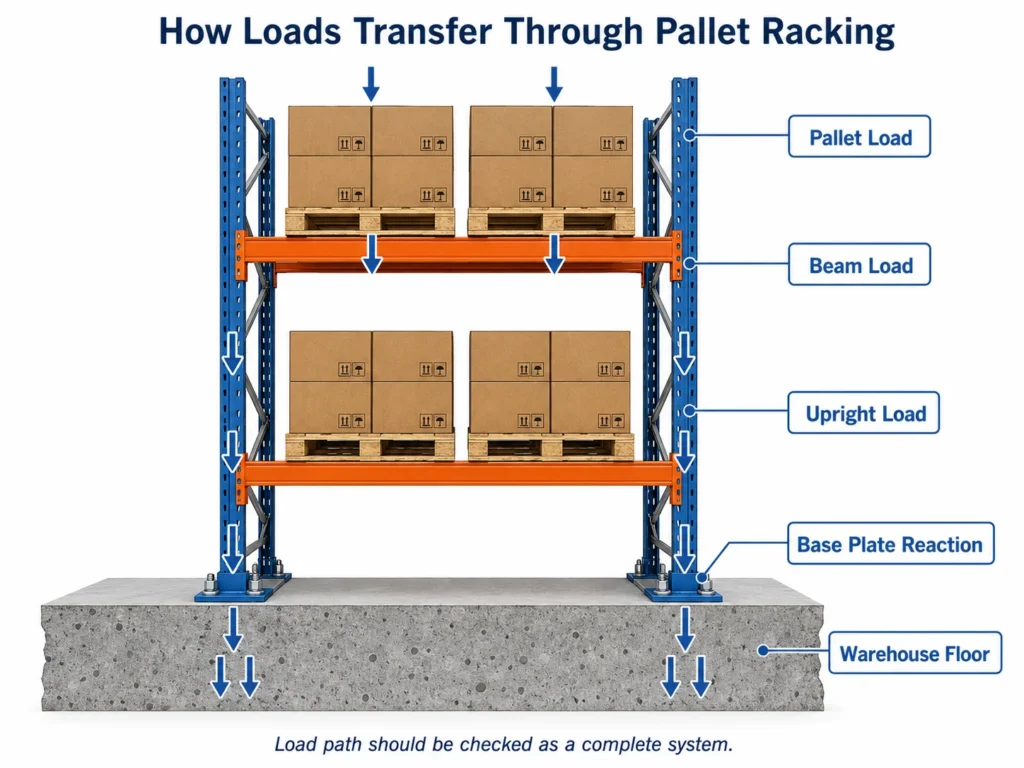
Pallet rack weight capacity does not mean one single number for the whole rack. In a real warehouse project, several load concepts must be separated.
| Term | Simple meaning | Why it matters |
| Pallet load | Weight of one loaded pallet | Starting point for rack design |
| Beam load | Load carried by one pair of beams | Determines load per level |
| Upright load | Load transferred through the vertical frame | Affected by rack height and beam spacing |
| Bay load | Total load in one rack bay | Helps check the complete bay configuration |
| Row load | Load distributed along a rack row | Important for layout and floor review |
| Floor capacity | Ability of the slab to support base reactions | Separate from rack capacity |
A simple load path is:
Pallet load → Beam load → Upright load → Base plate reaction → Warehouse floor
If one part of this load path is not suitable, the complete system should be reviewed.
Beam Capacity: Why Beam Span and Load Distribution Matter
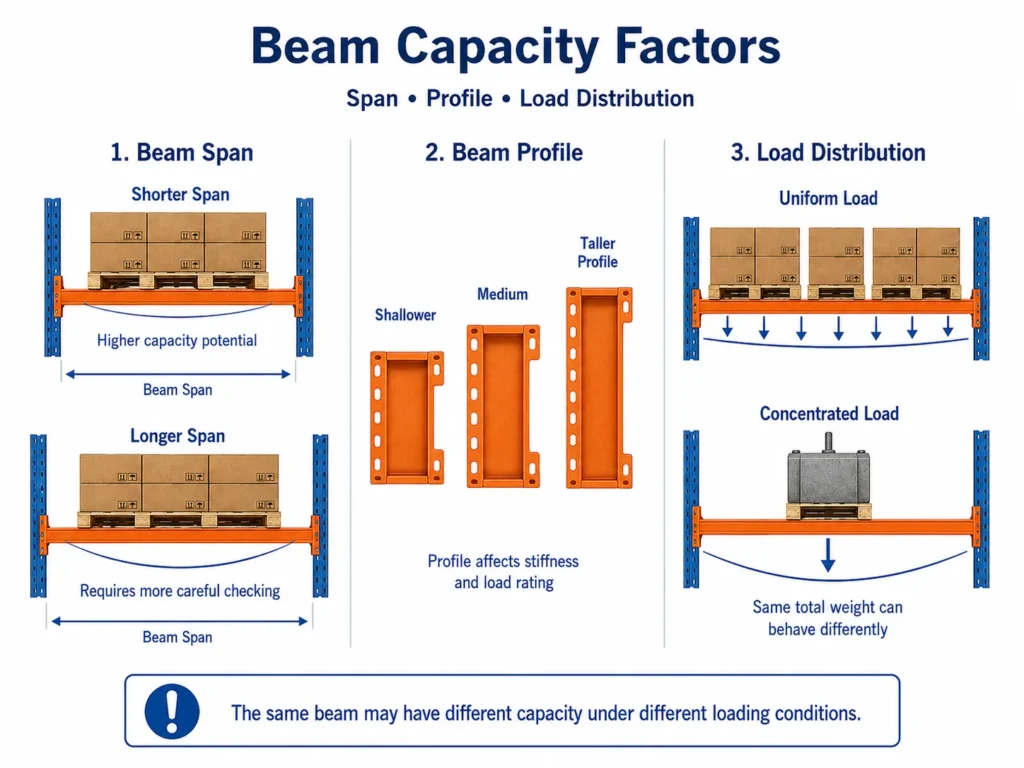
Beam capacity usually refers to how much load a pair of horizontal beams can support at one storage level.
For buyers, the most important factors are:
- Beam clear span
- Beam profile
- Beam connector
- Number of pallets per level
- Maximum pallet weight
- Load distribution
- Pallet support condition
- Beam deflection requirement
Beam span
A longer beam usually requires more careful capacity checking than a shorter beam of the same profile.
For example, a rack level designed for two pallets and a rack level designed for three pallets may need different beams, even if the pallet weight is the same.
Load distribution
Not all pallet loads behave the same.
A rack level carrying evenly stacked cartons is different from one carrying:
- Steel coils
- Machinery bases
- Drums
- IBC tanks
- Stone blocks
- Metal parts
- Uneven or off-center loads
When the load is concentrated rather than evenly distributed, the beam and pallet support arrangement should be reviewed more carefully.
Pallet support
The pallet itself is part of the load path. A strong beam does not solve a weak or incompatible pallet.
Check whether the pallet:
- Rests correctly on both beams
- Has suitable bottom boards
- Is damaged or deformed
- Is plastic, wooden, steel or custom-made
- Needs pallet support bars, wire decking or steel decking
If the pallet base is not suitable, the load may not transfer safely into the beams.
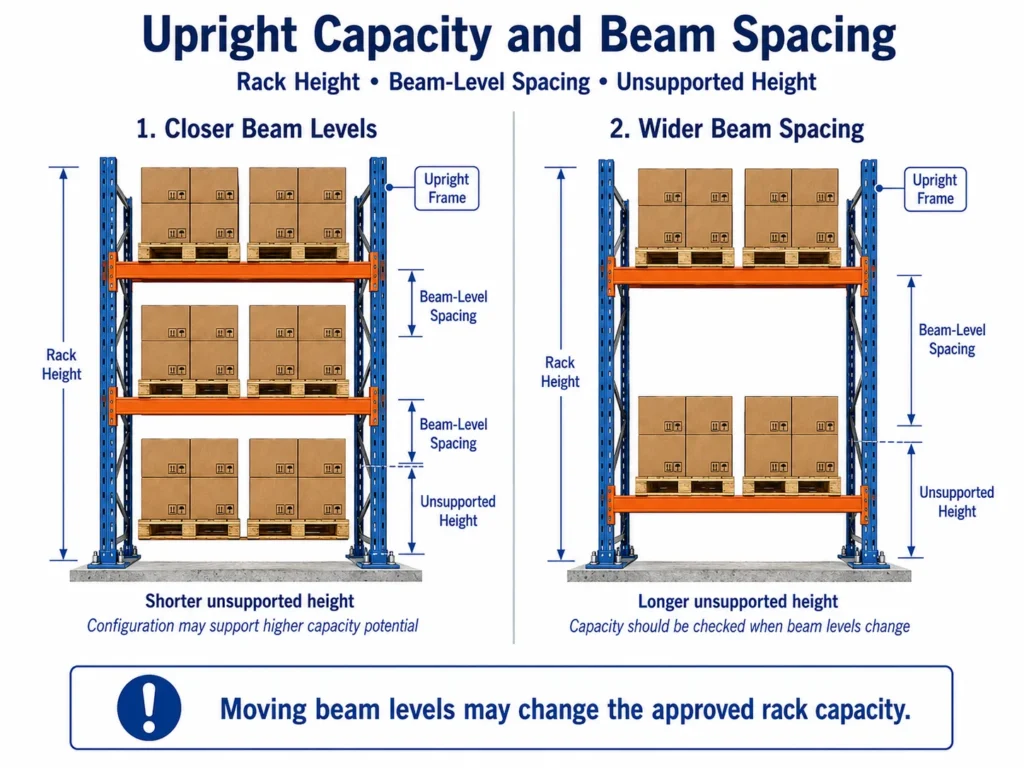
Upright Capacity: Why Rack Height and Beam Spacing Matter
Upright capacity depends on the complete frame configuration, not only on the upright post size.
Key factors include:
- Rack height
- Beam-level spacing
- Number of storage levels
- Frame depth
- Bracing configuration
- Base plate
- Anchoring
- Row spacers
- Rack row layout
- Seismic location
- Installation quality
Why beam spacing matters
When beam levels are moved farther apart, the unsupported height of the upright changes. That can change the frame capacity.
This means a rack with the same upright may have different load ratings under different beam layouts.
For this reason, buyers should not only ask for the upright size. They should ask what beam elevations and bay loads the quote is based on.
Adding more levels is not just adding beams
If you add another beam level, the total load in the bay increases. The supplier should check whether the uprights, bracing, base plates, anchors and floor are still suitable.
This is especially important when a customer wants to increase storage capacity after the rack has already been installed.
Rack Capacity Is Not the Same as Floor Capacity
A rack can be strong enough on paper, but the warehouse floor may still be the weak point.
Rack capacity refers to the steel rack structure: beams, uprights, connectors, bracing, base plates and anchors.
Floor capacity refers to the concrete slab and supporting ground. Heavy rack columns transfer concentrated forces into the slab through base plates and anchors.
| Concept | What it checks | Who usually reviews it |
| Rack capacity | Beams, uprights, connectors, bracing and anchors | Rack supplier or rack engineer |
| Floor capacity | Slab thickness, concrete condition, base reactions and concentrated loads | Local structural or civil engineer |
| Layout capacity | Number of usable pallet positions | Warehouse planner / rack supplier |
| Operational capacity | Throughput, access and daily movement | Warehouse operator |
A rack supplier can provide layout drawings and base reaction information when required, but the warehouse floor may need local review, especially for:
- Heavy pallet loads
- High rack systems
- Mezzanine systems
- AS/RS projects
- Older warehouses
- Unknown slab conditions
- Seismic areas
Do not assume that “heavy duty pallet racking” automatically means the floor is suitable.
Why Capacity Charts Are Only a Starting Point
Many buyers search for a pallet rack weight capacity chart. A chart can be useful in the early stage, but it should not be used as the final design basis.
A chart may help compare:
- General beam series
- Approximate beam spans
- Basic load ranges
- Light, medium and heavy-duty rack options
But a chart often does not show the full project conditions, such as:
- Upright frame capacity
- Beam-level spacing
- Total bay load
- Connector performance
- Anchoring
- Floor capacity
- Seismic requirements
- Pallet condition
- Installation tolerances
- Local project requirements
ANSI MH16.1-2023 specifies minimum requirements for the structural design, testing and utilization of industrial steel storage racks, including rack-supported systems and some automated storage and retrieval systems. It also covers several rack types such as push-back, pallet-flow, case-flow racks, pick modules and rack-supported platforms.
In practice, this means the final capacity should be based on the rack configuration, not just a general product chart.
Why Two Rack Quotes with the Same Capacity May Not Be Equal
Two suppliers may both write “2,000 kg per level,” but the quotations may not be based on the same design.
Before comparing prices, check the details behind the load rating.
| Quote item | Why it affects the price |
| Beam span | Longer spans may require stronger beams |
| Beam profile | Different beam sections can have different capacity and cost |
| Upright frame | Height, depth and bracing affect steel usage |
| Beam levels | More levels increase bay load |
| Load distribution | Concentrated loads may need stronger support |
| Pallet supports | Often required for weak or non-standard pallets |
| Anchors and base plates | Important for load transfer and stability |
| Row spacers | Needed for back-to-back rows |
| Protection accessories | Upright protectors and barriers affect project cost |
| Surface finish | Cold storage, humidity or corrosion exposure may change requirements |
| Installation scope | Supply-only and installed projects are not comparable |
| Freight and packaging | Overseas projects must include shipping and unloading conditions |
A lower price may simply mean fewer components, lighter sections, fewer accessories or a different scope.
A useful question to ask suppliers is:
“What assumptions is this capacity based on?”
What Information Is Needed for a Capacity-Based Quotation?
A supplier cannot give a reliable rack capacity recommendation from warehouse area alone.
Prepare the following information before requesting a quotation.
Warehouse information
- Warehouse layout or CAD drawing
- Available length and width
- Clear height
- Column positions
- Door and dock locations
- Sprinkler or fire restrictions
- Floor information if available
- Operating temperature
- Seismic location if required
Load information
- Pallet width and depth
- Loaded pallet height
- Maximum pallet weight
- Product overhang
- Pallet type and condition
- Load distribution
- Number of SKUs
- Required pallet positions
Operation information
- Forklift type and model
- Maximum lifting height
- Required aisle width
- FIFO or LIFO requirement
- Daily inbound and outbound volume
- Picking frequency
- Future expansion plan
Project information
- Preferred rack type
- Supply-only or installation scope
- Destination port or delivery address
- Site measurement responsibility
- Required drawings or BOQ format
- Project schedule
With this information, the supplier can prepare a more realistic layout and quotation instead of giving a rough price based only on rack size.
How to Compare Supplier Quotations
When comparing pallet rack quotations, do not start with the unit price. Start with whether the design basis is the same.
Use this checklist:
| Item | What to confirm |
| Maximum pallet load | Are all suppliers using the same unit load? |
| Pallets per level | Are they quoting the same storage arrangement? |
| Beam span | Are beam lengths and clear openings the same? |
| Beam profile | Are beam sections comparable? |
| Upright frame | Are frame height, depth and bracing comparable? |
| Beam levels | Are storage levels and elevations the same? |
| Bay load | Is the total load per bay clearly shown? |
| Accessories | Are pallet supports, protectors, row spacers and anchors included? |
| Drawings | Is it only a layout drawing or also structural documentation? |
| Installation | Is installation, supervision or guidance included? |
| Logistics | Are packaging, freight, unloading and destination terms included? |
For overseas buyers, this is especially important. A factory quotation, FOB quotation, CIF quotation and installed project quotation are not the same.
Common Mistakes When Checking Pallet Rack Capacity
1. Asking only for “load per level”
Load per level is important, but it is not enough. The buyer should also check beam span, upright configuration, total bay load and floor condition.
2. Comparing beam capacity only
A strong beam does not guarantee the whole rack system is suitable. Uprights, connectors, bracing, anchors and floor slab also matter.
3. Ignoring beam-level spacing
Changing beam levels can change upright capacity. This is common when customers later store taller pallets.
4. Using average pallet weight
Rack design should consider the maximum pallet weight, not only the average weight.
5. Ignoring pallet condition
Damaged or weak pallets may not sit properly on beams. Pallet supports or decking may be required.
6. Treating rack capacity and floor capacity as the same
They are different checks. A rack may be suitable while the floor still needs review.
7. Buying by price per ton only
Price per ton does not show whether the rack configuration, accessories, anchors, protection and installation scope are comparable.
8. Reconfiguring racks without checking drawings
RMI explains that LARC means Load Application and Rack Configuration. These drawings show the maximum loads and allowable beam positions for a rack system. RMI advises users not to change rack configurations without checking the LARC drawings and consulting a qualified design professional.
Does a Stronger Rack Always Mean a Better Rack?
Not always.
A rack should match the real warehouse operation. Over-designing every component can increase steel weight, freight cost and installation cost without improving warehouse performance.
The better approach is to balance:
- Required pallet load
- Storage capacity
- Direct pallet access
- Forklift operation
- Floor condition
- Expansion plan
- Safety accessories
- Project budget
- Local requirements
For example, a warehouse storing medium-weight cartons does not need the same configuration as a warehouse storing heavy industrial molds.
The goal is not to buy the heaviest rack. The goal is to buy the right rack for the actual load and operation.
Capacity Considerations by Rack Type
Different pallet racking systems transfer loads in different ways.
| Rack type | Capacity points to check |
| Selective pallet racking | Beam span, upright frame, pallet support and aisle impact risk |
| Drive-in racking | Pallet rail load, lane depth, forklift clearance and pallet condition |
| Push-back racking | Cart load, rail system, pallet stability and LIFO operation |
| Pallet flow racking | Roller capacity, slope, brake system and pallet quality |
| Radio shuttle racking | Rail support, shuttle clearance, lane depth and fault recovery access |
| AS/RS racking | Rack tolerance, stacker-crane interface, load positioning and floor accuracy |
This section is not meant to replace individual system design. It simply shows why the same pallet weight may require different rack checks in different storage systems.
How DJ Storage Rack Supports Capacity-Based Projects
For project buyers, the rack should not be treated as only a standard product. It should be reviewed together with the warehouse layout, pallet load, forklift operation and project scope.
DJ Storage Rack supports:
- Factory-direct rack manufacturing
- Custom racking configuration
- CAD warehouse layout support
- BOQ quotation for project orders
- Selective, drive-in, push-back, pallet flow, mezzanine and AS/RS-ready structures
- Rack configuration support for distributors, system integrators, EPC contractors and industrial warehouses
- Export packaging and project delivery coordination
For capacity-related inquiries, send your warehouse layout, pallet dimensions, maximum pallet weight, forklift information and required pallet positions. Our team can review the preliminary rack configuration and prepare a project-based quotation.
Conclusion
Pallet rack weight capacity is not only a beam rating. It depends on the complete rack configuration, including pallet load, beam span, upright frame, beam-level spacing, load distribution, anchoring and floor condition.
A capacity chart can help buyers understand the basic options, but it should not replace a project-specific review. When comparing suppliers, make sure each quotation is based on the same load, same beam span, same rack height, same number of levels and same supply scope.
If you are planning a warehouse racking project, prepare your warehouse drawing, pallet dimensions, maximum pallet weight and forklift model before requesting a quote. This will help the supplier recommend a more suitable pallet racking system and avoid misleading price comparisons.
CTA: Send your warehouse layout, pallet dimensions, maximum load and forklift information for an initial rack capacity review.
FAQ
What is pallet rack weight capacity?
Pallet rack weight capacity is the load a rack system can support under a specific configuration. It depends on pallet weight, beam span, upright frame, beam-level spacing, load distribution, anchoring and floor condition.
How much weight can a pallet rack hold?
There is no universal answer. A pallet rack can hold different loads depending on its beam span, upright configuration, number of storage levels, pallet type, load distribution and site conditions.
Is beam capacity the same as rack capacity?
No. Beam capacity refers to the load carried by one pair of beams. Rack capacity also includes uprights, connectors, bracing, anchors, bay load and the full rack configuration.
Is rack capacity the same as floor capacity?
No. Rack capacity refers to the steel storage structure. Floor capacity refers to whether the concrete slab can support base reactions, anchor forces and concentrated loads from the rack.
Can I use a pallet rack weight capacity chart?
Yes, but only for early comparison. A capacity chart may not include upright capacity, beam spacing, anchoring, floor condition, seismic requirements or pallet support conditions.
Why do two suppliers quote different prices for the same load?
The load rating may be based on different beam spans, beam profiles, upright frames, accessories, anchors, installation scope or freight terms. Always compare the design basis, not only the stated capacity.
What information is required for a pallet rack capacity quotation?
You should provide warehouse layout, clear height, pallet dimensions, maximum pallet weight, loaded height, required pallet positions, forklift model, rack type, floor information and installation scope.