Short Answer
Cantilever racking design starts with the dimensions, weight and stiffness of the stored material. The most important decisions are arm length, spacing between supporting uprights, load distribution, number of storage levels and handling equipment.
Arm length mainly relates to the front-to-back depth of the load, while upright spacing determines where the material is supported along its length. These dimensions should not be confused.
A rack designed for rigid steel sections may not provide suitable support for flexible pipes of the same length. Buyers should also check loading position, floor conditions, forklift access and whether storage is required on one or both sides.
The final configuration should be verified against the actual loading arrangement and project requirements.
1. What Information Is Needed Before Designing Cantilever Racking?
The first step is to describe the materials being stored.
Warehouse area alone is not enough to select the arms, uprights or support spacing.
| Required Information | Why It Matters |
|---|---|
| Material type | Identifies rigidity, shape and support requirements |
| Maximum material length | Influences upright spacing and number of supports |
| Front-to-back load depth | Helps determine arm projection |
| Maximum bundle weight | Establishes the required design load |
| Material stiffness | Affects sagging and load distribution |
| Bundle dimensions | Determines stacking height and loading clearance |
| Number of bundles per level | Influences the overall loading arrangement |
| Handling equipment | Determines access and lifting requirements |
| Indoor or outdoor location | Influences environmental design conditions |
| Floor information | Supports base and anchoring review |
Start with the largest, heaviest and most difficult-to-handle loads expected in the warehouse, not only the average product.
If several material types will share one rack, identify their differences before selecting a common configuration.
For an introduction to the system and its components, see What Is Cantilever Racking?.
2. Cantilever Arm Length vs Upright Spacing: What Is the Difference?
Arm length and upright spacing describe two different directions.
Arm Length
Arm length is the distance the support extends outward from the upright toward the aisle.
It is related to the load’s front-to-back depth, contact area and intended position on the arm.
Upright Spacing
Upright spacing is measured along the rack row between supporting columns. It determines the distance between support points along the stored material.
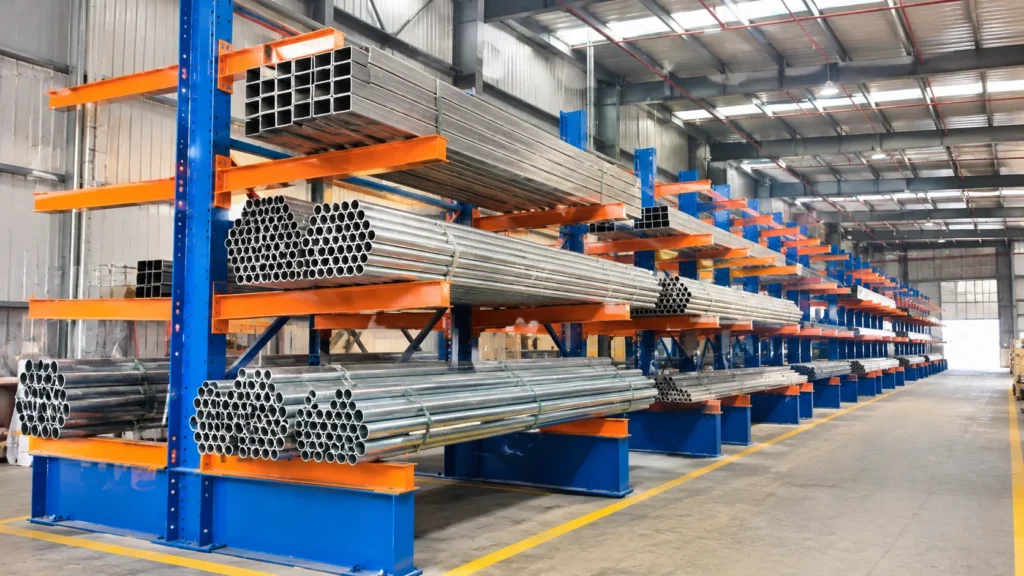
For example, a long steel pipe bundle may extend across several uprights, while each arm projects only far enough to support the bundle’s front-to-back depth.
| Dimension | Direction | Main Purpose |
|---|---|---|
| Arm length | Upright toward aisle | Supports the load depth |
| Upright spacing | Along the rack row | Establishes support intervals |
| Vertical arm spacing | Between storage levels | Provides load height and handling clearance |
| Overall rack height | Floor to top of rack | Defines the vertical storage arrangement |
Confusing arm projection with material length can lead to an unsuitable initial specification.
3. How to Choose Cantilever Arm Length
Arm length should match the way the stored material rests on the supports.
For a single load, the full front-to-back load depth should be supported within the approved arm arrangement. The load should not project beyond the arm tip unless an engineered configuration specifically permits it.
Check the Actual Load Depth
Measure the complete load, including packaging, wrapping and irregular product edges.
For bundled pipes or profiles, confirm the loaded bundle depth rather than using the diameter or width of one individual item.
Check Load Position
A load placed close to the arm tip can create greater bending demand than the same load positioned nearer the upright.
The intended loading position must therefore be part of the arm capacity assessment.
If several loads are to be stored from back to front on one arm, the combined loading arrangement must be included in the design.
Check Load Restraint
Round pipes, tubes and other products that may roll or shift require particular attention.
End stops or other load-retaining accessories may be appropriate, but they must suit the actual material and handling method.
They do not replace adequate structural support.
Buyer check: Ask the supplier what load depth and loading position the quoted arm capacity is based on.
4. How to Determine Cantilever Rack Support Spacing
There is no universal upright spacing suitable for all long materials.
The correct support interval depends on material length, stiffness, weight distribution, allowable product deflection and the way loads are positioned.
Rigid Materials
Structural steel sections or other relatively rigid products may distribute loads differently from flexible products.
The number and location of supports still need to account for the bundle configuration and loading tolerance.
Flexible Materials
Long plastic pipes and other flexible products may sag between supports.
A design that uses too few support points can leave the stored material poorly supported even if the arms themselves have sufficient nominal capacity.
Closer spacing or additional support points may be necessary, subject to technical review.
Mixed Material Lengths
When a warehouse stores several lengths of material, the shortest product may not rest on the same number of arms as the longest product.
The layout must account for the permitted storage positions of each product group.
| Storage Condition | Main Design Response |
|---|---|
| Long, relatively rigid bundles | Check support positions and load distribution |
| Long, flexible products | Review sagging and additional support requirements |
| Short products mixed with long products | Confirm minimum support engagement |
| Unevenly shaped bundles | Review contact points and load stability |
| Loads placed off-center | Account for unequal reactions between arms |
| Multiple bundles on one level | Check the complete loading arrangement |
A Practical Selection Sequence
For preliminary planning:
- Identify the shortest and longest materials to be stored.
- Confirm the maximum bundle weight and its rigidity.
- Identify the intended support points along the material.
- Review whether any product could bend excessively between supports.
- Check the effects of material overhang and possible off-center placement.
- Have the proposed arrangement verified against the structural design requirements.
Do not select upright spacing simply because it matches a standard product drawing.
5. Cantilever Rack Load Capacity: What Does the Rating Actually Mean?
A cantilever rack must support more than the weight carried by one individual arm.
The load is transferred through the arms and their connections into the uprights, bases, anchors and supporting floor.
| Capacity Item | What Buyers Should Confirm |
|---|---|
| Arm capacity | Load rating, arm projection and assumed load position |
| Arm connection | Compatibility with the approved arm load |
| Upright capacity | Number, elevation and loading of the arms |
| Bracing | Configuration needed for the rack arrangement |
| Base assembly | Reactions from the selected loading condition |
| Anchoring | Requirements for the installation location |
| Floor | Suitability for the resulting concentrated loads |
Can Bundle Weight Be Divided Equally Between the Arms?
Not automatically.
Consider a long bundle resting on several support arms.
A simple average calculation assumes each arm receives the same share of the load. This may not represent actual conditions when the bundle is flexible, unevenly positioned or supported at different contact points.
An off-center bundle may place more weight on an end arm than on other supports.
The rack designer must evaluate the load distribution using the expected material and placement conditions.
Why Arm Capacity Alone Is Not Enough
A quoted rating such as “1,000 kg per arm” is incomplete without the corresponding configuration and rating conditions.
Buyers should ask:
- What arm projection does this rating apply to?
- What load position and distribution were assumed?
- How many arms support each bundle?
- What loading is permitted on each upright?
- What happens when one side of the rack is loaded differently from the other?
- What drawings or engineering documents support the quotation?
A supplier comparison should use the approved load configuration rather than a nominal capacity figure alone.
For a new cantilever racking project, the rack structure and floor support should be checked separately.
6. Single-Sided vs Double-Sided Cantilever Racking
Single-sided and double-sided configurations serve different warehouse layouts.
| Factor | Single-Sided | Double-Sided |
|---|---|---|
| Access | One side | Both sides |
| Common placement | Warehouse perimeter | Central storage rows |
| Arm arrangement | One direction | Two directions |
| Forklift access | One operating face | Both operating faces |
| Typical layout benefit | Uses perimeter space | Provides storage on both sides of one row |
| Key structural consideration | One-sided loading | Combined and potentially unequal side loading |
Choose single-sided racking when material access is required from one side, especially in suitable perimeter locations.
Consider double-sided racking when the warehouse has sufficient aisle space on both sides and the storage operation benefits from two loading faces.
A double-sided rack should not be assumed to remain equally loaded at all times. Normal operations can leave one side partially loaded or empty.
The design must account for the relevant loading conditions.
7. Rack Height, Floor Conditions and Forklift Access
Cantilever racking dimensions should also match the warehouse and handling equipment.
Rack Height and Vertical Spacing
Rack height depends on the loaded material height, number of storage levels, handling clearance and equipment reach.
Vertical arm spacing must allow operators to lift products clear of the supports without striking the level above.
Flexible products may deflect during handling, requiring additional clearance.
Building obstructions, fire protection equipment and local requirements may also limit usable rack height.
Base and Floor Conditions
The base transfers structural forces from the upright to the supporting floor.
Important considerations include:
- Rack loading and base reactions
- Base geometry
- Anchor arrangement
- Concrete slab condition
- Floor joints and nearby obstructions
- Local structural requirements
The rack manufacturer’s capacity information does not establish that the existing floor is adequate.
Forklift and Crane Access
Handling long materials is different from handling ordinary pallets.
The layout should be checked against the equipment used, such as counterbalance forklifts, side loaders, multidirectional trucks or suitable lifting systems.
Confirm:
- Maximum material length during transport
- Equipment lifting and load-handling capability
- Turning and maneuvering space
- Required aisle clearance
- Operating direction
- Access to upper rack levels
- Pedestrian and vehicle separation
A forklift that can lift the load weight may still be unsuitable for safely maneuvering a long bundle in the proposed aisle.
8. How Design Requirements Change by Material
The stored product should influence the support arrangement and rack accessories.
| Material | Main Concern | What to Review |
|---|---|---|
| Steel pipes | Rolling and bundle movement | Support position and suitable restraints |
| Steel beams and profiles | Concentrated weight and loading position | Arm reactions and support spacing |
| Timber bundles | Length variation and stacking condition | Support engagement and load stability |
| PVC pipes | Flexibility and potential sagging | Additional supports and material deflection |
| Aluminum profiles | Surface damage and deformation | Contact protection and support arrangement |
| Flat panels or sheets | Support continuity and bending | Suitable deck or support configuration |
| Mixed long materials | Different weights and dimensions | Separate permitted loading arrangements |
When Is Cantilever Racking Less Suitable?
Cantilever racking may not be the most practical choice when goods require continuous support that ordinary spaced arms cannot provide.
Additional decking or a different storage system may be necessary for certain flexible, fragile or small loose products.
If individual items cannot be handled safely using the planned forklift or lifting equipment, the material-handling method should be reviewed before finalizing the rack.
9. Indoor vs Outdoor Cantilever Racking
Indoor and outdoor cantilever racks should not automatically use the same configuration.
Outdoor projects may involve corrosion, rain, wind, temperature changes and different foundation conditions.
| Condition | Design Consideration |
|---|---|
| Dry indoor warehouse | Coating and routine operational exposure |
| Humid warehouse | Corrosion protection and inspection requirements |
| Outdoor yard | Environmental loads, foundation and drainage |
| Coastal location | Potentially more demanding corrosion exposure |
| Rack with canopy | Additional roof and environmental loading |
| Cold environment | Material, operating and handling conditions |
Surface treatment should be selected according to the exposure environment and project specification.
For example, galvanizing may be considered for certain outdoor applications, while coated steel may be suitable in controlled indoor conditions.
Any canopy, roof or weather protection arrangement should be included in the structural assessment rather than treated as a minor accessory.
10. Common Design and Purchasing Mistakes
Mistake 1: Selecting Arm Length From the Total Material Length
Arm projection relates mainly to front-to-back load depth and position. Overall material length influences the supporting arrangement along the row.
Better approach: Measure both dimensions separately.
Mistake 2: Assuming Equal Load on Every Arm
Flexible or off-center loads can create unequal reactions.
Better approach: Provide the supplier with material stiffness, bundle weight and placement information.
Mistake 3: Ignoring the Shortest Stored Product
A support arrangement designed around the longest material may be unsuitable for shorter items.
Better approach: Confirm support engagement across the full product range.
Mistake 4: Choosing the Highest Nominal Capacity
Higher nominal arm capacity does not automatically mean the complete rack is suitable.
Better approach: Compare approved load configurations and structural scope.
Mistake 5: Overlooking Material Handling
A rack may fit inside the warehouse while leaving insufficient room for handling long loads.
Better approach: Review forklift or crane movement before confirming the layout.
Mistake 6: Comparing Incomplete Quotations
A cheaper quotation may exclude accessories, structural documentation, packaging or other required components.
Better approach: Compare quotations against one agreed technical and commercial specification.
11. What Information Should Buyers Send for a Cantilever Rack Quotation?
A useful quotation request describes the load, the warehouse and the required supply scope.
Material Information
- Material type
- Minimum and maximum material length
- Load depth and height
- Maximum bundle weight
- Material stiffness or flexibility
- Number of bundles to be stored
- Product shape and packaging
- Required storage levels
Warehouse and Handling Information
- Warehouse layout or CAD drawing
- Clear height and available floor area
- Column positions and obstructions
- Forklift or lifting equipment model
- Indoor or outdoor location
- Available floor information
- Fire protection constraints
- Project location
Purchasing Information
- Single-sided or double-sided preference
- Required quantity of rack rows
- Surface treatment requirements
- Required accessories
- Destination port
- Export packaging requirements
- Installation responsibility
- Required engineering documents
Example: A Useful Load Specification
The following format can be copied into an inquiry.
| Specification | Buyer Input |
|---|---|
| Stored material | Steel pipes / Timber / Profiles / Other |
| Material length range | ___ to ___ mm |
| Maximum bundle weight | ___ kg |
| Bundle depth × height | ___ × ___ mm |
| Product flexibility | Rigid / Flexible / To be confirmed |
| Number of bundles | ___ |
| Required storage levels | ___ |
| Handling equipment | ___ |
| Available clear height | ___ mm |
| Rack preference | Single-sided / Double-sided / Undecided |
| Installation location | Indoor / Outdoor |
| Destination country or port | ___ |
Where important information is not yet available, identify it clearly rather than substituting an assumed value.
Planning a long-material storage project?
Send your material specifications, warehouse drawing and handling requirements for an initial cantilever rack configuration review.
12. How to Compare Cantilever Racking Supplier Quotations
Before comparing prices, confirm that suppliers are quoting the same intended storage arrangement.
| Quotation Item | Comparison Question |
|---|---|
| Arm projection | Are the arms the same length? |
| Support spacing | Are the upright positions comparable? |
| Load rating | Is the rating based on equivalent load conditions? |
| Storage levels | Is the number and height of levels the same? |
| Rack configuration | Are both quotes single-sided or double-sided? |
| Bracing and base | Is the structural supply scope equivalent? |
| Load restraints | Are required stops and accessories included? |
| Surface finish | Is the coating specification the same? |
| Technical documents | Are the agreed drawings and calculations included? |
| Packaging | Is export packaging included? |
| Delivery | Are Incoterms and destination consistent? |
| Installation | Who is responsible for local installation and approval? |
Do not compare only the total steel weight or quoted unit price. Two systems with similar dimensions may have different support arrangements, rating conditions and supply scopes.
13. Cantilever Racking Project Support from DJ Storage Rack
DJ Storage Rack, operated by Dongjian Racking Manufacturing Co., Ltd., is a China-based manufacturer of industrial warehouse racking systems.
For cantilever racking procurement, the company supports customized rack supply, preliminary warehouse layout coordination and project-based BOQ quotations.
The initial review can cover stored material dimensions, loading requirements, proposed rack configuration and handling conditions.
For overseas projects, manufacturing, packaging, delivery terms and the responsibility for local installation should be confirmed in the agreed project scope.
Final structural calculations, site anchoring and local regulatory approvals must be addressed through the appropriate project engineering process.
Explore our cantilever racking system for product information and project inquiries.
Conclusion
A cantilever rack should be specified around the actual material and its handling requirements.
Arm projection, horizontal support spacing and permitted loading arrangements are separate decisions that need to work together.
Before requesting a quotation, confirm the full material dimensions, maximum bundle weight, loading method, warehouse conditions and project scope.
This gives suppliers a common basis for comparing configurations and reduces the risk of quotations that look similar but are not technically equivalent.
Request a Cantilever Racking Quotation
Send your material dimensions, maximum load, warehouse layout and handling equipment information.
WhatsApp / Phone: +86 1935551 8784
Email: info@dj-rack.com
Frequently Asked Questions
How do you choose cantilever rack arm length?
Arm length should be based on the front-to-back depth of the stored load, its position on the arm and the required support arrangement. It should not be selected from the overall length of pipes or timber alone.
How far apart should cantilever rack uprights be?
Upright spacing depends on material length, rigidity, weight distribution, allowable product deflection and the number of support points. There is no universal spacing suitable for every long material.
Can cantilever rack load weight be divided equally among supporting arms?
Only when the assumed distribution is justified. Flexible materials and off-center placement can create unequal arm reactions. The designer should evaluate the actual loading arrangement.
What is the difference between arm capacity and upright capacity?
Arm capacity applies to a specified arm under defined loading conditions. Upright capacity considers the combined loads and moments transferred from the attached arms under the approved rack configuration.
Is single-sided or double-sided cantilever racking better?
Single-sided racks are often practical along warehouse perimeters. Double-sided racks provide access from both sides and may improve central storage arrangements. The choice depends on layout, handling access and loading conditions.
Can cantilever racking store flexible plastic pipes?
It may be suitable when adequate support and load restraint are provided. Flexible pipes can sag between support points, so material stiffness, support spacing and handling requirements need to be reviewed.
Can cantilever racking be installed outdoors?
Yes, if designed for the outdoor environment. Corrosion protection, wind and other environmental loads, foundation conditions and the stability of stored materials should be considered.
What information is needed for a cantilever racking quotation?
Provide material type, length range, bundle dimensions, maximum weight, stiffness, storage quantity, handling equipment, warehouse layout, indoor or outdoor conditions, project location and required supply scope.