

Short Answer
A pallet rack inspection should cover the condition of upright frames, beams, beam connectors, locking pins, bracing, base plates, anchors, pallets, load distribution and surrounding warehouse conditions. Visible damage, missing components, unstable loads, forklift impact marks and changes to the rack configuration should be recorded and assessed rather than ignored.
Warehouse operators can carry out routine visual checks as part of their site procedures. However, suspected structural damage, significant deformation, anchor problems or unauthorized modifications should be referred to a qualified rack professional. The appropriate inspection frequency and acceptance criteria depend on local requirements, the rack manufacturer’s guidance, operating conditions and project-specific risk assessments.
Key Takeaways
- Inspect upright frames, beams, connectors, braces, base plates and anchors for visible damage.
- Check whether pallets are in good condition and loads are stable and correctly positioned.
- Review forklift impact areas, aisle obstructions and rack protection.
- Make sure load information and rack configuration records are available and understandable.
- Record damage and report concerns instead of making unauthorized repairs.
- Do not assume that rack load capacity and concrete floor capacity are the same.
- Use qualified professionals for structural assessments and repair decisions.
1. Why Pallet Rack Safety Inspections Matter
Pallet racking is exposed to repeated loading, unloading and material-handling activities. Forklift contact, unsuitable pallets, uneven load distribution, unauthorized modifications and changes in warehouse operations can all affect the condition of a storage system.
A rack that appears generally intact may still have problems at individual connections, base plates or load-supporting components.
For warehouse operators and project managers, regular inspection procedures help identify visible concerns before they are overlooked during daily operations.
Common risk factors include:
- Forklift impact on upright frames and rack protectors
- Damaged or unsuitable pallets
- Loads that extend beyond the intended support area
- Missing or damaged beam locking components
- Loose or damaged anchors
- Changes to beam levels or rack configuration
- Corrosion or environmental exposure
- Floor cracking or signs of settlement around rack bases
- Obstructed aisles and restricted emergency access
The purpose of an inspection is not simply to confirm that a rack is still standing. It is to identify changes in its condition and determine whether further assessment is necessary.
2. What Should Be Included in a Pallet Rack Inspection?
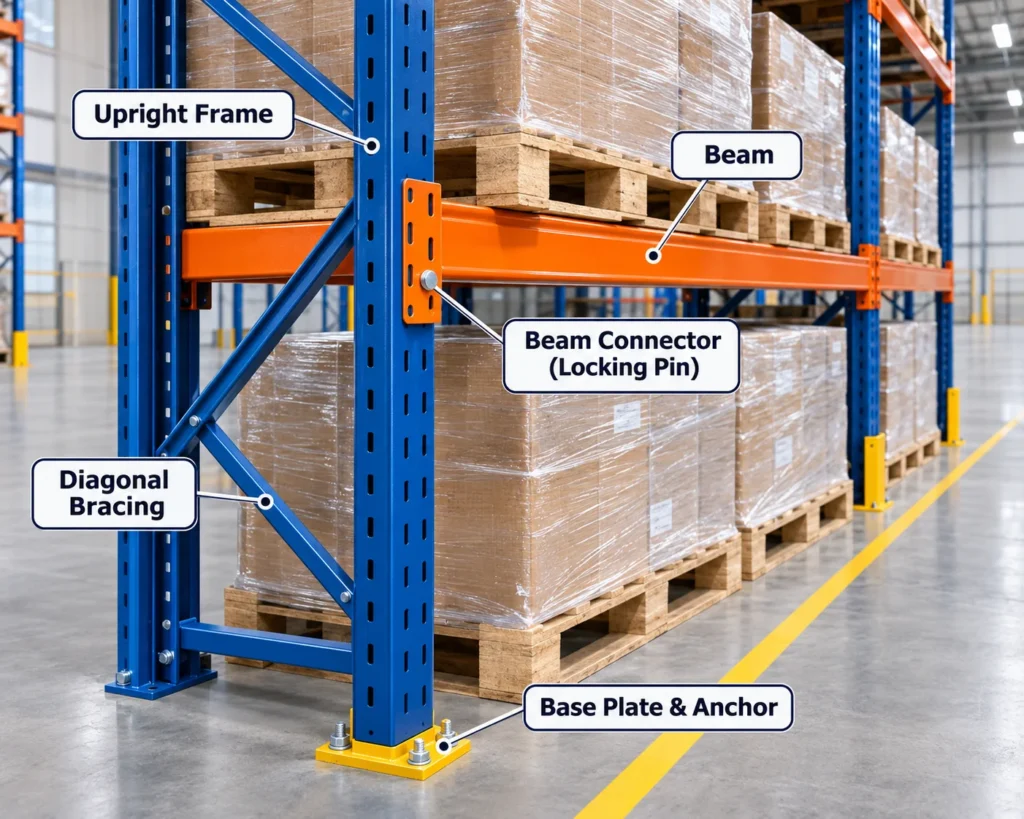
A practical pallet rack inspection checklist should cover the complete storage system rather than focusing only on the upright frames.
2.1 Upright Frame Inspection
Upright frames support the vertical loads transferred through the rack structure. Their condition should receive particular attention, especially in areas exposed to forklift traffic.
Check for:
- Visible bending or deformation
- Dents and impact marks
- Twisted or damaged upright sections
- Damaged horizontal or diagonal bracing
- Missing or visibly damaged frame connections
- Signs of corrosion
- Evidence of unauthorized drilling, cutting or modification
Pay particular attention to the lower sections of uprights, where forklift contact may occur during loading and unloading.
A visual inspection alone cannot establish whether a damaged upright remains structurally acceptable. Do not apply an assumed deformation limit or decide that a frame is safe based only on its appearance.
Where deformation or significant damage is suspected, the affected area should be referred for professional assessment.
2.2 Beam and Connector Inspection
Beams transfer pallet loads to the upright frames through their connecting components.
Inspect:
- Beam surfaces for visible bending or damage
- Beam-end connectors for deformation
- Welded areas for visible cracking
- Connector engagement at both ends
- Missing or damaged locking pins, where used
- Signs that beams have been displaced
- Unauthorized changes to beam positions
A beam that appears different from its original condition should be reviewed.
It is also important to distinguish between normal beam deflection under an applied load and permanent deformation or damage. The acceptable condition should be checked against the manufacturer’s specifications and applicable engineering requirements.
Do not remove, reposition or adjust loaded beams as part of an informal inspection.
2.3 Bracing and Frame Connections
Bracing helps maintain the intended configuration of the upright frames.
Check:
- Horizontal bracing
- Diagonal bracing
- Frame connection points
- Missing or damaged components
- Loose or visibly damaged fasteners
- Row spacers and their connections, where applicable
Missing or damaged bracing should not be treated as a minor cosmetic issue. Its structural significance depends on the rack configuration and requires appropriate technical review.
2.4 Base Plates and Anchor Inspection
Base plates and anchors connect the rack structure to the concrete floor.
Inspect the visible condition of:
- Base plates
- Anchor bolts
- Anchor connections
- Concrete around the base plates
- Signs of cracking or surface damage
- Evidence of movement or settlement
- Corrosion around exposed connections
A damaged anchor or cracked concrete near a rack base may require further assessment.
Do not assume that tightening an anchor bolt or replacing one component will resolve the underlying problem. The correct repair method depends on the anchor type, floor condition, rack configuration and applicable project requirements.
2.5 Pallet and Load Inspection
The pallet is part of the overall storage arrangement. Its condition and the way goods are loaded can affect how loads are supported by the rack.
Check:
- Broken or damaged pallet boards
- Damaged pallet blocks or bottom supports
- Uneven load distribution
- Unstable or leaning goods
- Excessive product overhang
- Pallets that do not fit the intended storage position
- Loads that exceed the approved configuration
- Inconsistent pallet dimensions within the same storage area
Do not assume that a pallet is suitable simply because it fits between the rack beams.
Pallet dimensions, bottom construction, load distribution and pallet condition should all be considered.
2.6 Rack Safety Accessories
Safety accessories help reduce the consequences of certain operational risks, but they do not replace correct rack design or inspection.
Depending on the system, check:
- Upright protectors
- End-of-aisle guards
- Safety locking pins
- Pallet support bars
- Wire decking
- Protective mesh
- Pallet backstops
- Other specified safety components
Look for missing, displaced, bent or damaged accessories.
Where protective components are part of the approved rack configuration, replacements should match the intended system and installation requirements.
2.7 Aisle Clearance and Warehouse Conditions
Rack safety also depends on how the warehouse is operated.
Review:
- Forklift travel paths
- Clear access to storage locations
- Aisle obstructions
- Pedestrian and vehicle interaction areas
- Building columns and nearby obstructions
- Fire exits and emergency access
- Sprinkler and fire protection clearance
- Lighting and visibility
- Operating temperature and corrosive exposure
A rack layout that was suitable when first installed may need to be reviewed if warehouse operations, handling equipment or building conditions change.
3. Pallet Rack Inspection Checklist
The following table can be used as a practical visual review checklist by warehouse teams.
It is an observation and reporting tool, not a substitute for a formal inspection standard or engineering assessment.
| Inspection Area | What to Check | Action When a Concern Is Found |
|---|---|---|
| Upright frames | Bending, dents, twisting or impact marks | Record and request technical assessment |
| Beams | Visible deformation, damage or displacement | Review before further use of the affected location |
| Beam connectors | Cracks, deformation or incomplete engagement | Report and arrange assessment |
| Locking pins | Missing or damaged pins where specified | Restore according to manufacturer guidance |
| Bracing | Missing, damaged or displaced members | Refer for structural review |
| Base plates | Visible damage or movement | Record and investigate |
| Anchors | Missing, damaged or loose connections | Request appropriate assessment |
| Concrete floor | Cracking, spalling or settlement signs | Review floor and base conditions |
| Pallets | Broken boards or unsuitable bottom supports | Remove unsuitable pallets from the storage process |
| Loads | Unstable stacking or uneven distribution | Correct the loading arrangement safely |
| Rack protection | Damaged or displaced guards | Review and replace where required |
| Load information | Missing, unclear or inconsistent capacity signs | Confirm the approved load information |
| Aisles | Obstructions or restricted access | Restore the intended access route |
| Fire protection | Blocked or altered clearances | Refer to the approved fire protection layout |
For a more complete review, the inspection record should include the date, location, rack row, bay, level, observed condition, photographs and the person responsible for follow-up.
4. How to Recognize Common Pallet Rack Damage
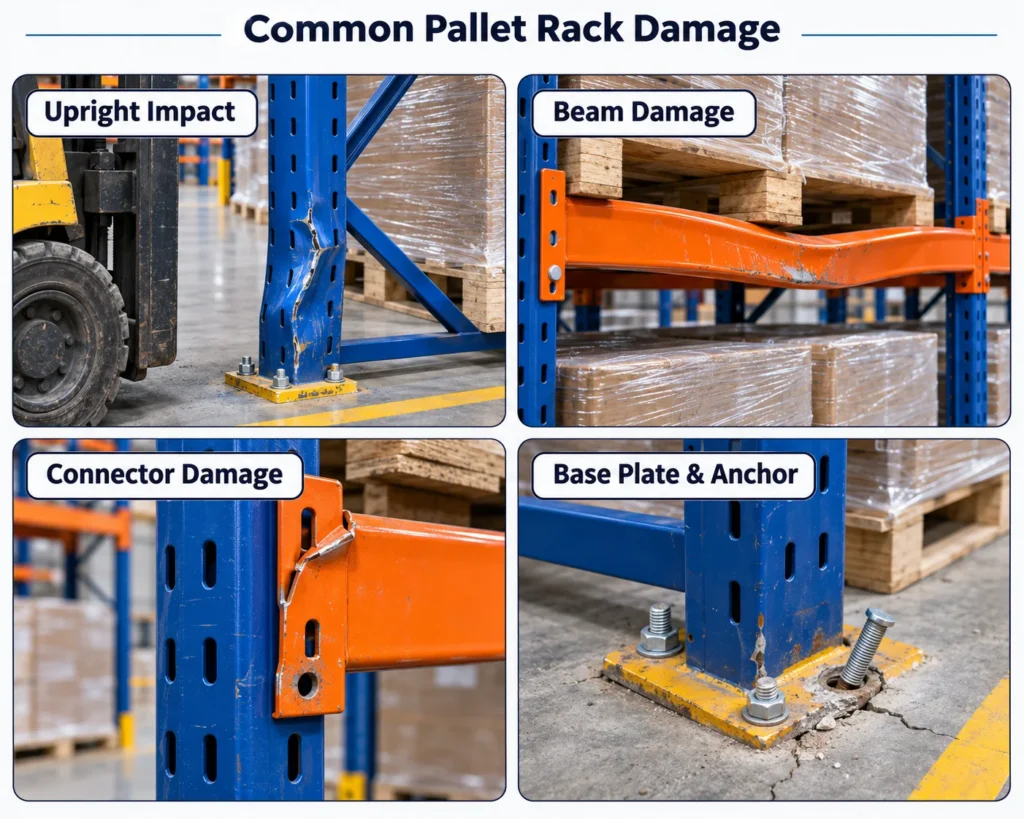
Some forms of damage are easy to overlook during normal warehouse operations.
Forklift Impact Damage
Forklift impact may leave dents, scratches, deformation or displacement on upright frames and protective components.
Pay attention to:
- Lower upright sections
- Aisle-end frames
- Rack corners
- Loading and unloading positions
- Areas with frequent forklift turning
Paint damage alone does not establish the severity of structural damage. The underlying steel condition and any visible deformation need to be considered.
Beam Deformation
Beams may be affected by loading conditions, impact or unauthorized changes.
Look for:
- Permanent changes in beam shape
- Damaged end connectors
- Visible cracks
- Signs of displacement
- Changes compared with the original configuration
Do not determine allowable beam deformation from a generic online chart. The relevant limits depend on the beam design, manufacturer specifications and engineering assessment.
Corrosion and Environmental Exposure
Warehouses operating in cold storage, humid environments or areas exposed to corrosive substances may require additional attention to surface and connection conditions.
Look for:
- Corrosion on exposed steel surfaces
- Deterioration around connections
- Damaged protective coatings
- Signs of water accumulation
- Changes in the condition of floor-level components
The appropriate protection and maintenance approach depends on the actual operating environment.
5. What Should You Do When Pallet Rack Damage Is Found?
Identifying damage is only the first step. The response should be controlled and documented.
Step 1: Record the Location and Condition
Document:
- Warehouse area
- Rack row and bay number
- Storage level
- Component affected
- Visible damage
- Current loading condition
- Photographs from suitable angles
Avoid moving loads or components simply to obtain better photographs.
Step 2: Control Access to the Affected Area
If structural damage or an unsafe condition is suspected, prevent further use of the affected rack location and follow the warehouse’s safety procedures.
If there is an immediate risk of instability, keep personnel away and follow the site’s emergency response procedure.
Do not attempt to unload an unstable rack without an appropriate assessment and safe unloading plan. Moving the load may create additional risk.
Step 3: Arrange a Qualified Assessment
Significant deformation, damaged connections, anchor problems and structural modifications should be reviewed by a qualified rack professional or engineer.
The assessment should consider the original rack configuration, loading information, damage location and relevant site conditions.
Step 4: Follow an Approved Repair or Replacement Procedure
Do not:
- Heat or straighten damaged uprights without approval
- Weld damaged rack components as an improvised repair
- Replace beams with unverified alternatives
- Remove bracing to create additional clearance
- Modify rack connections without technical approval
Repairs or replacements should follow the manufacturer’s requirements and an approved technical procedure.
Step 5: Document the Follow-Up
Record:
- The assessment findings
- Approved corrective actions
- Replaced or repaired components
- Verification of completed work
- Authorization to return the affected area to operation
A clear maintenance record helps warehouse teams track recurring problems and changes to the storage system.
6. How Often Should Pallet Racking Be Inspected?
There is no single inspection interval that should automatically be applied to every warehouse.
The appropriate inspection arrangement depends on:
- Local regulations and applicable requirements
- Rack manufacturer’s recommendations
- Warehouse operating conditions
- Forklift traffic and impact exposure
- Storage load characteristics
- Previous damage history
- Environmental conditions
- Changes to the rack configuration
A practical warehouse inspection program can include different levels of review:
Routine operator checks
Warehouse personnel can report visible damage, missing components, unstable loads and obstructions as part of site operating procedures.
Documented periodic reviews
A designated responsible person can review inspection records, recurring damage locations, load information and corrective actions.
Professional technical assessments
Qualified professionals should be involved when structural damage, significant deformation, modifications or uncertain load conditions are identified.
Additional review should be considered after forklift impact, relocation, modification, unusual loading events or other incidents that may affect rack condition.
The actual frequency and scope should be established according to applicable local requirements and professional guidance. This article does not establish a mandatory inspection interval.
7. Common Pallet Racking Safety Mistakes
Mistake 1: Inspecting Only the Upright Frames
Uprights are important, but beams, connectors, braces, anchors, pallets and the floor also need attention.
A complete review should consider the whole load-supporting system.
Mistake 2: Ignoring Minor Forklift Impacts
A small impact mark does not automatically mean a rack is unsafe. However, repeated impacts and visible deformation should not be ignored.
Record the condition and arrange an appropriate assessment.
Mistake 3: Assuming the Rack Is Safe Because It Is Still Standing
The absence of obvious collapse does not establish that every component is in acceptable condition.
Connections, anchors and load-supporting components may require closer examination.
Mistake 4: Treating Rack Capacity as Floor Capacity
Rack load capacity and warehouse floor capacity are different engineering considerations.
The rack structure transfers loads through its base plates and anchors to the floor. The concrete slab and supporting ground must also be suitable for the resulting reactions.
For more information, read our pallet rack weight capacity guide.
Mistake 5: Making Unauthorized Repairs
Straightening, welding, drilling or replacing rack components without an approved procedure may change the original structural configuration.
Repairs should be based on an appropriate technical assessment.
Mistake 6: Ignoring Changes in Warehouse Operations
Changes in pallet dimensions, load weights, forklift equipment, rack height or storage configuration may affect the original design assumptions.
A rack system should be reviewed when significant operating conditions change.
8. How to Reduce Pallet Rack Damage in Daily Operations
Inspection helps identify problems, but warehouse operating practices also influence rack condition.
Consider the following measures:
- Train forklift operators to approach rack locations carefully.
- Keep designated forklift aisles clear.
- Use rack protection where required by the approved layout.
- Avoid storing damaged or unsuitable pallets.
- Follow approved pallet loading and positioning arrangements.
- Keep load capacity information visible and consistent with the installed configuration.
- Prevent unauthorized changes to beam levels and structural components.
- Record repeated forklift impact locations.
- Review rack conditions after operational changes.
- Keep inspection and maintenance records.
Rack protection, operator training and proper loading practices should work together. No single accessory can eliminate all rack damage risks.
9. Information Needed for a Pallet Rack Safety Review
When a warehouse operator or project manager needs technical support, providing clear information can make the initial review more useful.
Prepare the following:
| Information | Details to Provide |
|---|---|
| Rack system type | Selective, Drive-In, Push Back, Pallet Flow or another system |
| Rack drawings | Original layout or CAD drawings, if available |
| Rack configuration | Height, beam levels and bay arrangement |
| Pallet dimensions | Width, depth and loaded height |
| Maximum pallet weight | Actual maximum unit load |
| Load arrangement | Load distribution and pallet support conditions |
| Forklift information | Equipment type and handling method |
| Damage location | Rack row, bay, level and component |
| Damage photographs | Clear views of the affected areas |
| Incident details | Forklift impact, modification or other known event |
| Floor information | Available slab drawings or relevant floor records |
| Operating environment | Temperature, humidity or corrosive exposure |
| Project location | Country and applicable local requirements |
If the warehouse is planning a new system or changing an existing layout, also provide the required pallet positions, SKU quantity, inventory rotation requirements and future expansion plans.
For general layout considerations, see our pallet racking dimensions guide.
10. How DJ Storage Rack Supports Warehouse Racking Projects
DJ Storage Rack is a factory-direct warehouse racking manufacturer supporting distributors, system integrators, EPC contractors and industrial warehouse projects.
Our project support focuses on the rack supply and configuration process, including:
- Warehouse CAD layout coordination
- Storage space and forklift route planning
- Pallet size and load information review
- Custom rack configuration
- BOQ-based project quotations
- Standardized and modular rack production
- Batch supply for project requirements
- Export packaging and delivery coordination
We supply warehouse storage systems including selective pallet racking, Drive-In Racking, Push Back Racking, cantilever racking, mezzanine systems and automation-compatible rack structures.
For existing rack damage, the actual site condition should be assessed by an appropriately qualified local professional. DJ Storage Rack’s product and project support does not replace a formal safety inspection, structural approval or local regulatory assessment.
If you are planning a new warehouse project, replacing rack components or reviewing a proposed storage configuration, our team can help review the relevant product and project information.
Send your warehouse layout, pallet dimensions, maximum load, forklift information and project requirements for an initial racking layout review and quotation.
Conclusion
Pallet rack safety inspections should cover more than visible damage to upright frames. Beams, connectors, bracing, anchors, pallets, loads, floor conditions, protective accessories and warehouse operating practices all deserve attention.
A practical inspection process should record concerns, control access to affected areas when necessary and involve qualified professionals when structural damage or uncertain conditions are identified.
For warehouse owners, distributors and project contractors, the most reliable approach is to combine suitable rack configuration, correct loading practices, appropriate protection and documented maintenance procedures.
A well-planned inspection process helps warehouse teams identify concerns earlier and make better-informed decisions about rack maintenance and project requirements.
Frequently Asked Questions
1. How often should pallet racking be inspected?
There is no single inspection interval suitable for every warehouse. The schedule should follow applicable local requirements, rack manufacturer guidance, site operating conditions and risk assessments. Routine operator checks, documented periodic reviews and professional assessments may form part of the overall inspection program.
2. What should be included in a pallet rack inspection checklist?
A checklist should cover upright frames, beams, connectors, locking pins, bracing, base plates, anchors, concrete floor conditions, pallets, load distribution, protective accessories, load information and warehouse access conditions.
3. Who should inspect pallet racking?
Warehouse personnel can carry out routine visual checks according to site procedures. Structural damage, significant deformation, modifications and uncertain load conditions should be assessed by a qualified rack professional or engineer. Formal inspection responsibilities depend on local requirements.
4. What are the common signs of pallet rack damage?
Common visible signs include bent upright frames, damaged beams, deformed connectors, missing locking pins, damaged bracing, loose or damaged anchors, corrosion and impact marks. These signs require appropriate assessment rather than assumptions based only on appearance.
5. Can damaged pallet racking be repaired?
Some rack components may be repairable, while others may require replacement. The decision depends on the damage, component design, rack configuration and manufacturer’s requirements. Repairs should follow an approved technical procedure rather than improvised welding or straightening.
6. Can a pallet rack be used if a beam locking pin is missing?
If the rack design requires a locking pin and it is missing, the affected connection should be treated as a safety concern. Prevent further use of the affected storage location until the correct component is restored and the connection is checked according to the manufacturer’s guidance.
7. Is pallet rack load capacity the same as warehouse floor capacity?
No. Rack load capacity relates to the structural capacity of the racking system. Floor capacity relates to the ability of the concrete slab and supporting structure to withstand the loads transferred through rack base plates and anchors. Both require appropriate review.
8. What information is needed for a pallet rack safety review?
Useful information includes rack drawings, rack type, pallet dimensions, maximum pallet weight, rack configuration, forklift information, photographs of damage, incident details and available floor information. The review scope should also identify the warehouse location and applicable local requirements.