Short Answer
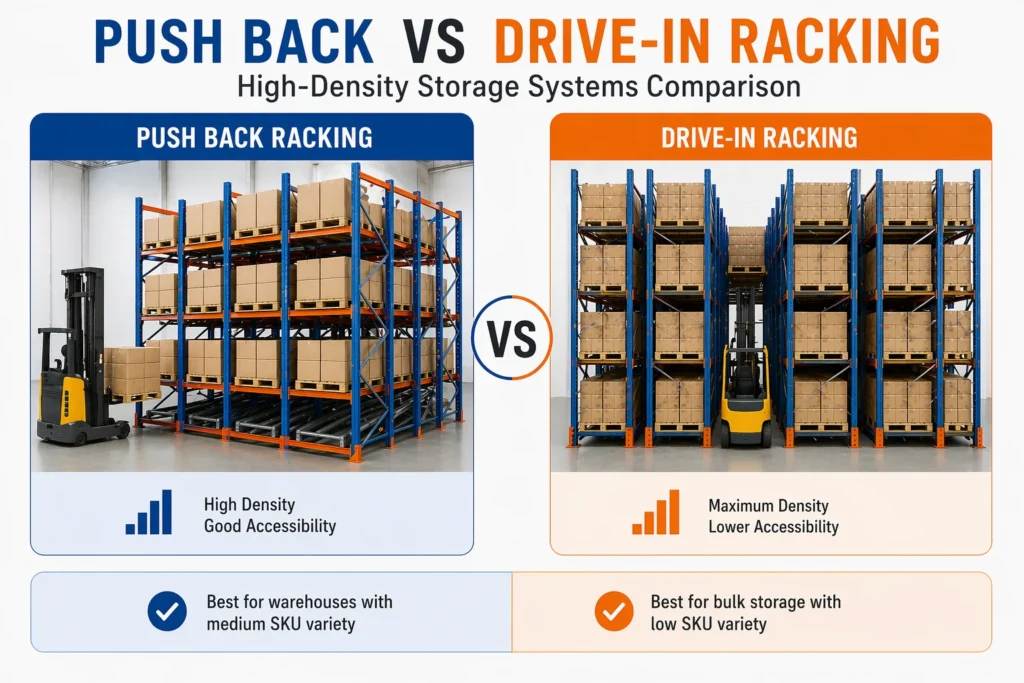
Push back racking offers better accessibility, safer operation, and faster pallet retrieval, making it ideal for warehouses with moderate SKU variety.
Drive-in racking provides maximum storage density and is best suited for bulk storage of the same product where space optimization is the top priority.
What Is the Difference Between Push Back and Drive-In Racking?
The key difference is how pallets are stored and retrieved.
- Push back racking is a dynamic system using gravity-fed carts, allowing pallets to move forward automatically
- Drive-in racking is a static deep-lane system where forklifts enter the rack structure
This impacts:
accessibility
safety
efficiency
storage density
Key Differences at a Glance
| Feature | Push Back Racking | Drive-In Racking |
|---|---|---|
| Access | Medium (front access) | Low (deep lane) |
| Storage Density | High | Very High |
| SKU Variety | Medium | Low |
| Safety | High | Medium |
| Operation | Gravity-assisted | Forklift inside rack |
| Inventory Method | LIFO | LIFO |
| Cost per Pallet Position | Medium | Lower |
How the Systems Work (Engineering Perspective)
Push Back Racking
- Uses inclined rails and carts
- Pallets are pushed backward when loading
- When unloading, pallets roll forward automatically
👉 This reduces forklift travel and improves picking speed
Drive-In Racking
- Pallets are stored in deep lanes
- Forklifts enter the rack structure
- Each lane holds a single SKU
👉 This maximizes storage density but limits access
Real Warehouse Scenarios (High Information Gain)
This is where most buying decisions happen.
Scenario 1 — Retail Distribution Warehouse
- Moderate SKU variety
- Frequent picking
- Need for efficiency
👉 Best choice: Push Back Racking
Scenario 2 — Cold Storage Warehouse
- High cost per square meter
- Bulk inventory
- Limited space
👉 Best choice: Drive-In Racking
Scenario 3 — Mixed Storage Facility
- Combination of bulk and varied SKUs
👉 Often uses:
Push Back + Drive-In hybrid solution
Storage Density vs Accessibility
This is the core trade-off.
- Push back racking: balanced system
- Drive-in racking: maximum density system
Typical comparison:
Push Back: 50–70% space utilization
Drive-In: 60–80% space utilization
👉 Higher density comes with reduced accessibility.
Advantages and Limitations
Push Back Racking
Advantages
- higher safety (forklift stays outside)
- faster operation
- better SKU flexibility
Limitations
- lower density than drive-in
- higher system complexity
Drive-In Racking
Advantages
- maximum storage density
- efficient use of warehouse space
- lower cost per pallet position
Limitations
- limited access
- higher forklift skill requirement
- increased risk of rack damage
Cost Comparison (Real Logic)
Many articles oversimplify cost.
The real comparison is:
cost per pallet position
Push Back Racking
- higher equipment cost
- lower operational time cost
Drive-In Rackin
- lower system cost
- higher operational risk and time
👉 For full cost breakdown:
pallet-racking-cost-guide
When NOT to Use Each System
Avoid Push Back Racking if:
- you need maximum density
- budget is very limited
- SKU is very low
Avoid Drive-In Racking if:
- frequent picking required
- SKU diversity is high
- safety is a major concern
Decision Framework
If you need flexibility → Choose Push Back
If you need maximum density → Choose Drive-In
More precise:
Medium SKU + efficiency → Push Back
Low SKU + bulk storage → Drive-In
From Selection to Implementation
Choosing the right system is only the first step.
A complete warehouse solution includes:
- layout design
- load calculation
- aisle optimization
- safety compliance
👉 Explore full system solutions:
/product/pallet-racking/
👉 Work with a manufacturer:
/pallet-racking-manufacturer/
Conclusion
Push back and drive-in racking systems are both high-density solutions, but they serve different operational needs.
- Push back prioritizes efficiency and safety
- Drive-in prioritizes maximum storage capacity
The best choice depends on your warehouse workflow, SKU structure, and space constraints.