Short Answer
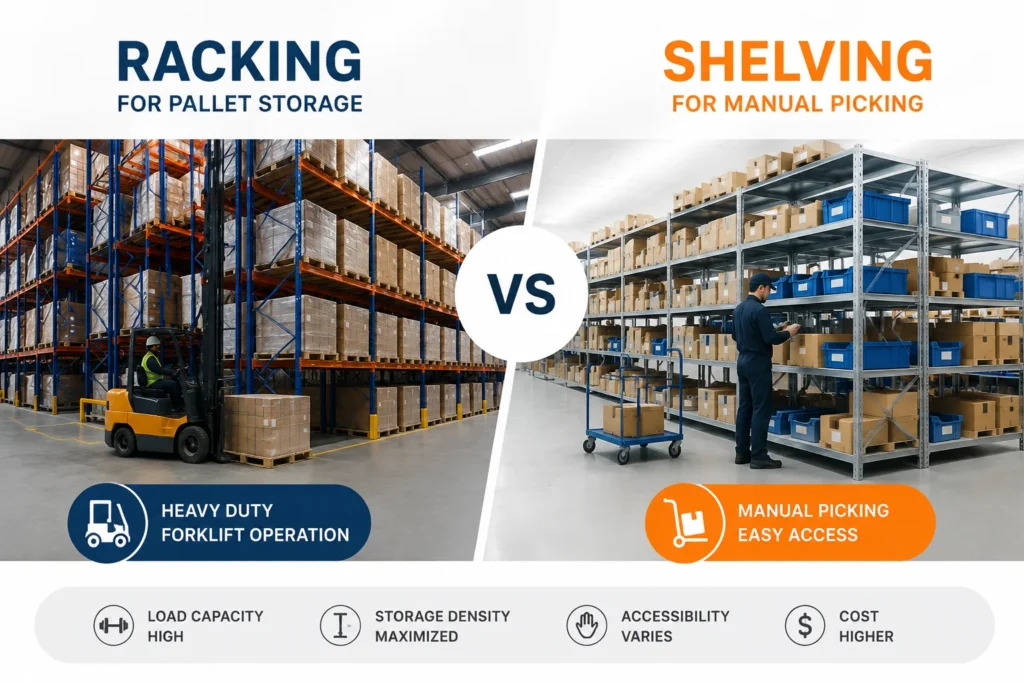
Racking systems are designed for heavy-duty pallet storage in warehouses and industrial facilities, while shelving systems are intended for lighter, manually handled inventory.
In warehouse operations:
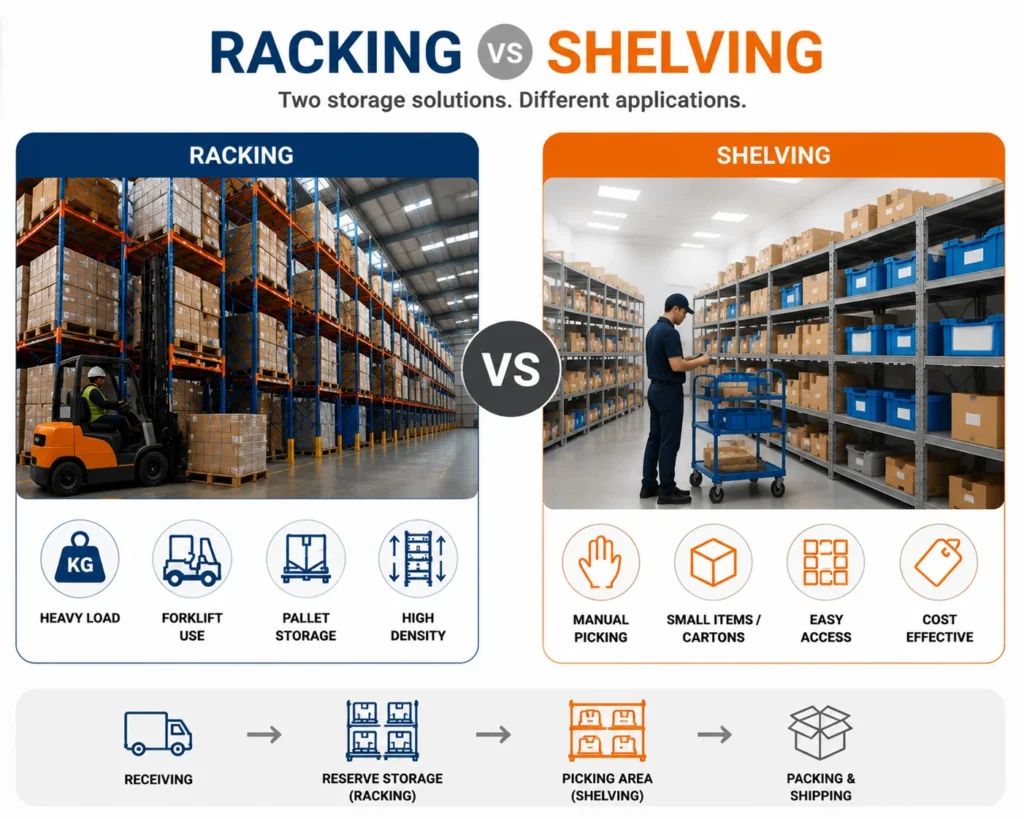
Racking = pallet storage and forklift operation
Shelving = manual picking and small-item organization
The right choice depends on load capacity, warehouse workflow, inventory type, and storage density requirements.
What Is Racking?
Racking refers to industrial storage systems engineered to store palletized and heavy-duty inventory.
These systems are commonly used in:
- distribution centers
- manufacturing facilities
- logistics warehouses
- bulk storage operations
Most racking systems are designed for forklift handling and vertical storage optimization.
Common racking systems include:
- selective pallet racking
- drive-in racking
- push back racking
- pallet flow racking
👉 Explore more:
types-of-pallet-racking-systems
What Is Shelving?
Shelving systems are designed for smaller, lighter inventory that can be stored and retrieved manually.
Shelving is commonly used in:
- e-commerce picking areas
- spare parts rooms
- retail storage
- office storage
- maintenance workshops
Unlike pallet racking systems, shelving generally does not require forklifts.
Key Differences Between Racking and Shelving
| Factor | Racking | Shelving |
|---|---|---|
| Load Capacity | Heavy-duty pallet loads | Light to medium loads |
| Handling Method | Forklift operation | Manual picking |
| Storage Type | Palletized inventory | Cartons and small items |
| Storage Density | High vertical density | High accessibility |
| Typical Height | 6–15m+ | 2–4m |
| Warehouse Role | Bulk storage | Picking and organization |
| System Cost | Higher | Lower |
Racking vs Shelving: The Real Operational Difference
The biggest difference is not the structure itself — it is how the warehouse operates.
Racking Systems Prioritize:
storage density
vertical space utilization
bulk inventory storage
Racking systems are optimized for storing large quantities of palletized goods efficiently.
Shelving Systems Prioritize:
manual accessibility
fast picking
small SKU organization
Shelving systems are designed to improve picking efficiency and inventory visibility.
How Racking and Shelving Work Together in Modern Warehouses
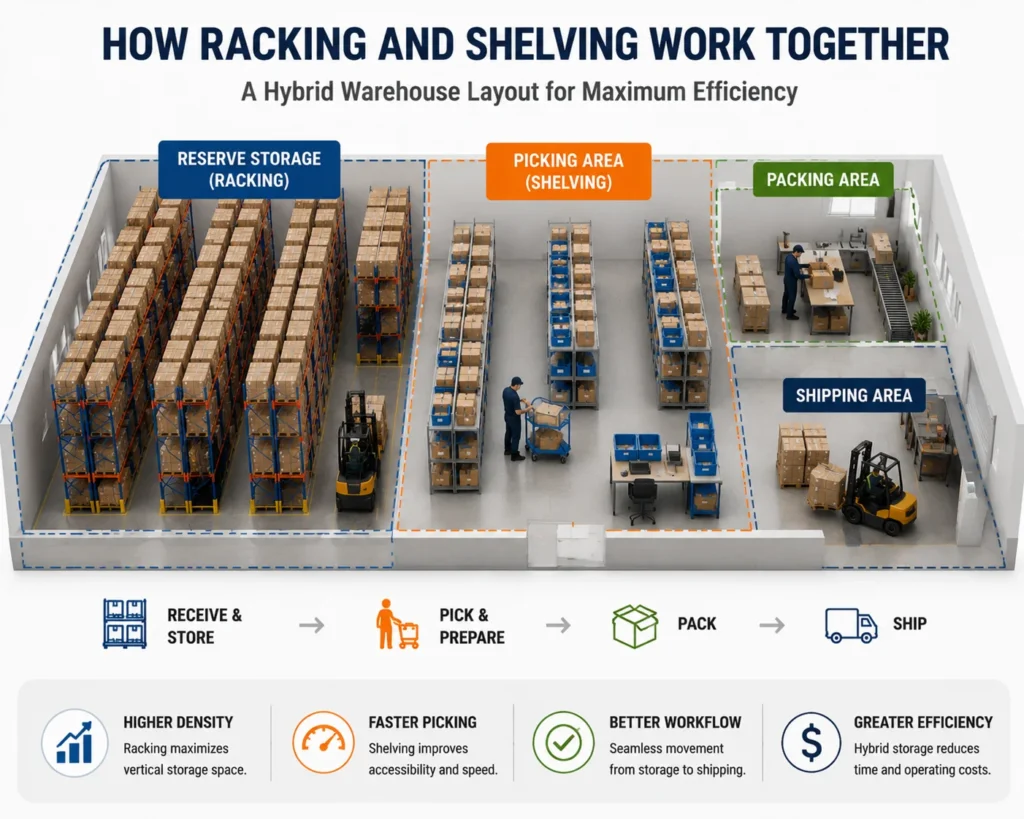
Modern warehouses rarely use only one system.
A typical warehouse workflow often includes:
| Warehouse Area | Recommended System |
|---|---|
| Reserve pallet storage | Racking |
| Picking zones | Shelving |
| Spare parts storage | Shelving |
| Bulk inventory | Racking |
| Packing areas | Shelving |
In many distribution centers:
Racking handles bulk pallet storage
Shelving supports picking and order fulfillment
This hybrid approach improves both storage density and operational efficiency.
Real Warehouse Scenarios
Scenario 1 — Distribution Center
Characteristics:
- palletized inventory
- forklift operation
- high throughput
👉 Best solution:
Pallet RackingScenario 2 — E-commerce Picking Area
Characteristics:
- many small SKUs
- frequent manual picking
- rapid order fulfillment
👉 Best solution:
Shelving SystemsScenario 3 — Spare Parts Warehouse
Characteristics:
- mixed inventory sizes
- combination of pallets and cartons
👉 Best solution:
Hybrid Storage LayoutUsing both racking and shelving systems together is often the most efficient approach.
Load Capacity Comparison
Load capacity is one of the most important differences.
Typical shelving systems:
50–300 kg per levelTypical pallet racking systems:
500–3000+ kg per levelRacking systems are engineered for structural load-bearing performance and heavy industrial storage.
Space Utilization and Warehouse Layout
Racking systems are optimized for:
maximum vertical storage densityShelving systems are optimized for:
manual access and picking efficiencyThis is why many warehouses use:
racking for reserve storage
shelving for picking operations
Cost Comparison
Shelving systems generally have:
- lower installation cost
- simpler assembly
- lower load requirements
Racking systems typically require:
- structural engineering
- forklift aisle planning
- higher load capacity calculations
👉 Learn more:
how-much-does-pallet-racking-cost
When Should You Choose Racking?
Choose racking if:
- inventory is palletized
- products are heavy
- forklifts are used
- warehouse height matters
- storage density is important
When Should You Choose Shelving?
Choose shelving if:
- manual picking dominates
- products are small or lightweight
- SKU quantity is high
- accessibility is the priority
From Storage Equipment to Warehouse Design
Modern warehouse planning usually combines multiple storage systems.
A complete warehouse solution may include:
- pallet racking
- shelving systems
- mezzanine platforms
- picking areas
- packing stations
👉 Explore pallet racking solutions:
https://www.djstoragerack.com/product/pallet-racking/
👉 Work with a warehouse storage manufacturer:
pallet-racking-manufacturer
Conclusion
Racking and shelving systems are designed for different warehouse functions.
- Racking prioritizes load capacity and storage density
- Shelving prioritizes accessibility and manual picking efficiency
The best solution depends on warehouse workflow, inventory type, and operational efficiency goals.