Short Answer
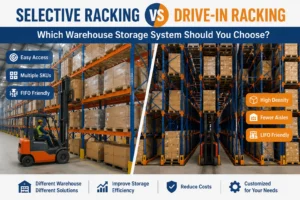
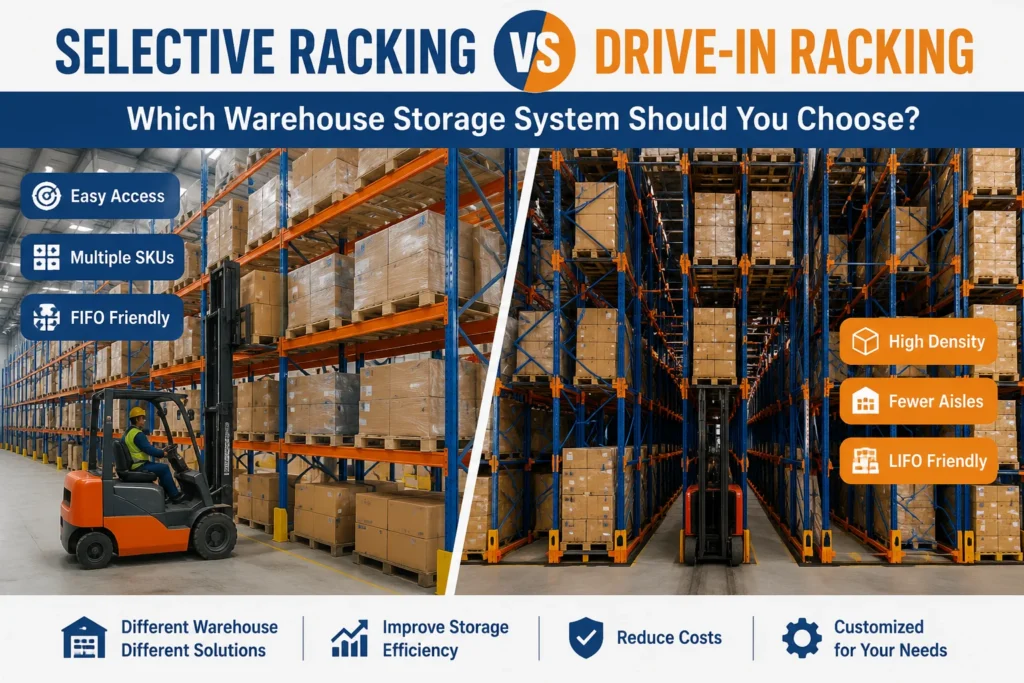
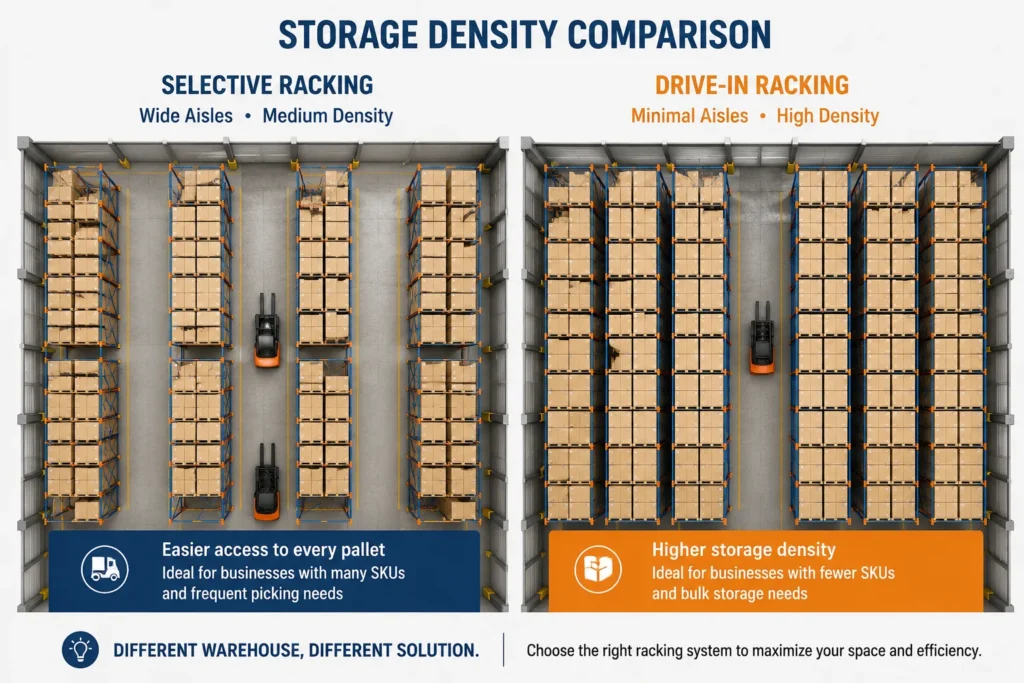
Selective pallet racking is ideal for warehouses that require direct access to every pallet and high SKU variety.
Drive-in racking provides maximum storage density, making it the best choice for bulk storage of the same SKU where space optimization is critical.
Quick Comparison Table
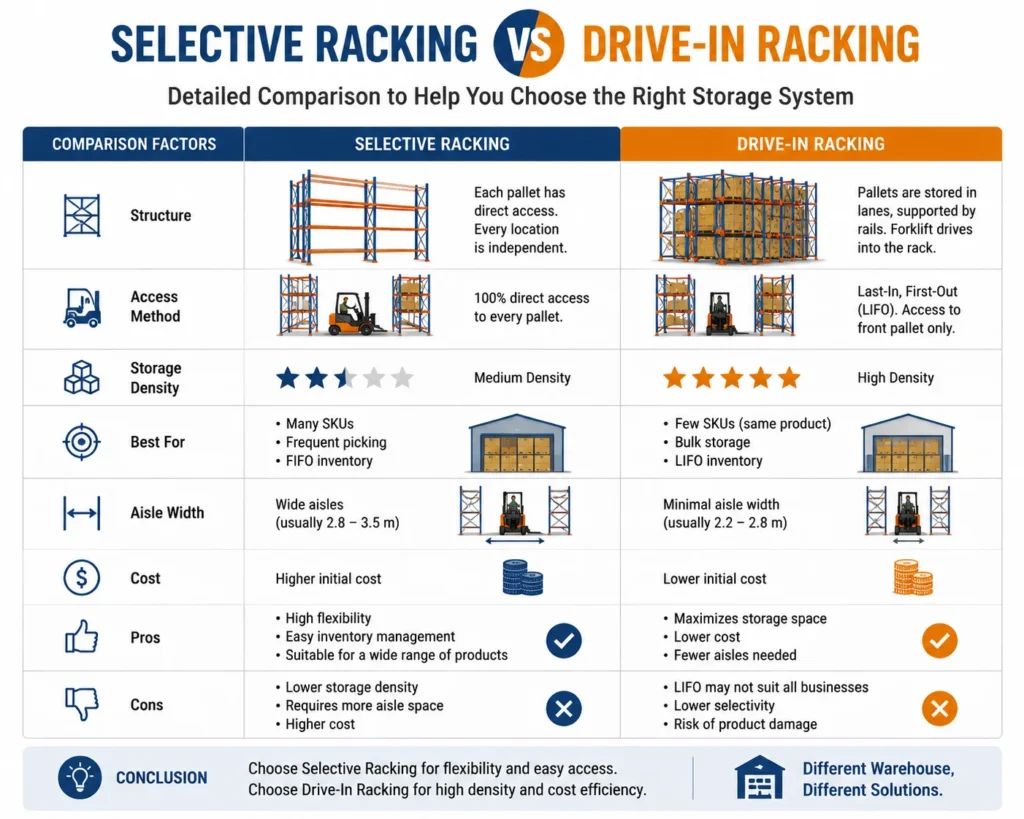
| Factor | Selective Racking | Drive-In Racking |
|---|---|---|
| Pallet Access | Direct | Limited |
| Storage Density | Medium | High |
| SKU Type | Multiple SKUs | Single / Low SKU |
| Aisle Space | Wide aisles required | Minimal aisles |
| Inventory Flow | FIFO | LIFO |
| Cost per Pallet Position | Higher | Lower |
| Operational Complexity | Low | Medium–High |
What Is Selective Racking?
Selective racking is a standard warehouse storage system with upright frames and horizontal beams, designed for high accessibility and flexibility.
- Suitable for high SKU variety and frequent picking
- Operates with forklifts for efficient pallet retrieval
- Easy to expand and reconfigure for future growth
👉 Explore more: types of pallet racking systems
What Is Drive-In Racking?
Drive-in racking is a high-density storage system where forklifts enter the rack structure to store and retrieve pallets.
- Ideal for bulk storage of the same SKU
- Reduces aisle space to maximize storage density
- Operates on a LIFO (Last-In, First-Out) inventory system
Real Warehouse Scenarios
| Scenario | Best Solution |
|---|---|
| Distribution Center with multiple SKUs & fast picking | Selective Racking |
| Cold Storage Warehouse for bulk inventory | Drive-In Racking |
| Spare Parts Warehouse with mixed inventory | Hybrid: Selective + Drive-In |
Advantages and Limitations
Selective Racking
Advantages:
- Direct pallet access
- Flexible layout
- Easy inventory management
Limitations:
- Lower storage density
- Requires wider aisles
Drive-In Racking
Advantages:
- Maximum storage density
- Efficient use of floor space
- Lower cost per pallet position
Limitations:
- Limited access to individual pallets
- Requires skilled forklift operation
- LIFO system only
Cost Considerations
- Selective racking: lower complexity, higher space usage
- Drive-in racking: higher initial complexity, lower cost per pallet position
👉 See detailed cost analysis: how much does pallet racking cost
Which System Should You Choose?
- Choose Selective Racking if:
High SKU variety, frequent picking, flexibility is critical - Choose Drive-In Racking if:
Bulk inventory, low SKU, space optimization is top priority - Hybrid layouts often combine both systems for maximum efficiency.
From System Selection to Warehouse Design
A complete warehouse design may include:
- Pallet Racking
- Shelving Systems
- Mezzanine Platforms
- Picking Zones
- Packing Stations
Internal links:
Conclusion
Selective and Drive-In racking systems are tailored to different warehouse needs:
- Selective Racking: Focused on accessibility and flexibility
- Drive-In Racking: Focused on density and space efficiency
Choosing the right system depends on warehouse workflow, SKU profile, and operational priorities.