Short Answer
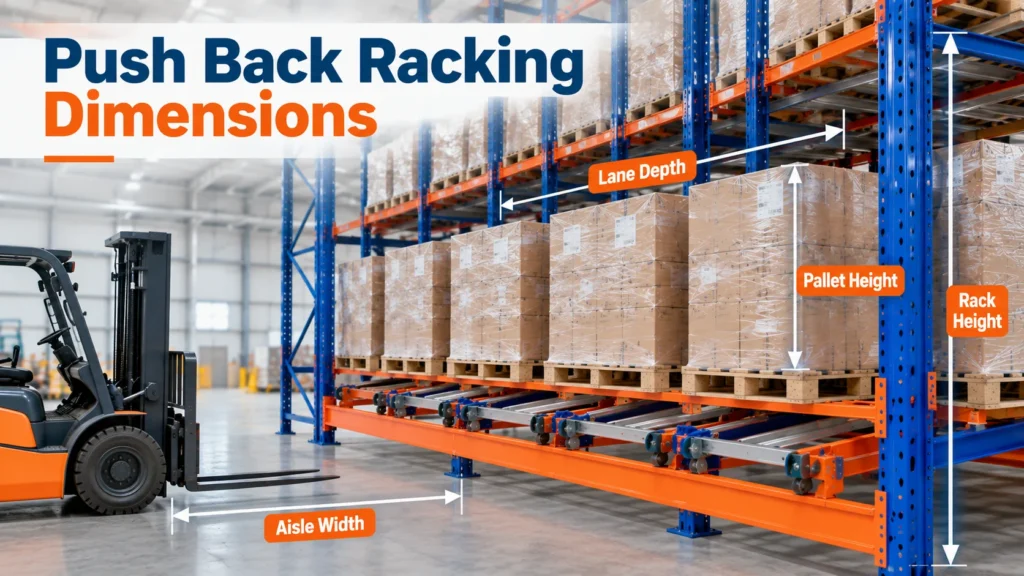
Push back racking dimensions should be planned around pallet size, pallet weight, loaded pallet height, lane depth, cart and rail structure, forklift access, rack height, floor condition and inventory flow. In many warehouse projects, push back racking is discussed as 2-deep, 3-deep, 4-deep, 5-deep or deeper lane storage, but deeper lanes do not automatically mean better warehouse efficiency.
The right lane depth depends on how many pallets are stored per SKU, whether LIFO operation is acceptable, whether pallets are stable, and how forklifts operate in the aisle. Before confirming a push back rack layout, buyers should provide warehouse drawings, pallet dimensions, maximum pallet weight, forklift model, required pallet positions and inventory rotation requirements.
Key Takeaways
- Push back racking dimensions cannot be selected only from a standard catalogue.
- Lane depth should match SKU quantity, pallet quantity per SKU and inventory turnover.
- Pallet size, pallet bottom condition and load stability directly affect cart and rail design.
- Rack height must be checked together with clear height, forklift lifting height and sprinkler clearance.
- A deeper push back lane may increase storage density, but it can also affect access, cost and operation control.
- Push back racking is normally used for LIFO pallet storage.
- Final rack configuration should be reviewed based on warehouse drawings, load information, equipment parameters and applicable local requirements.
What Are Push Back Racking Dimensions?
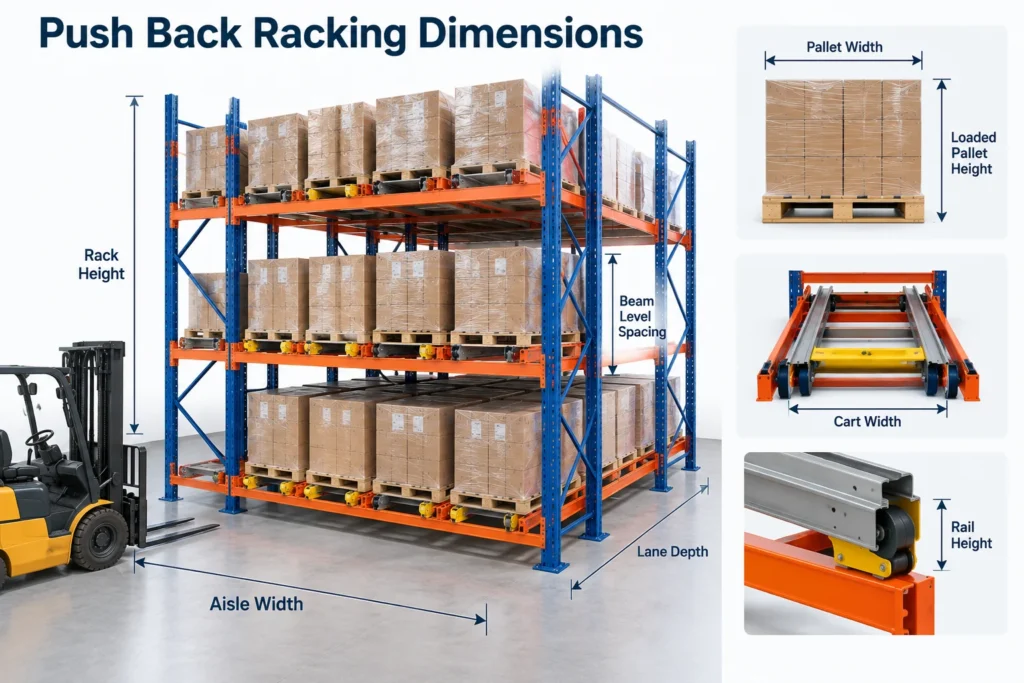
Push back racking dimensions refer to the actual rack size and layout conditions required for a push back pallet rack system to work safely and efficiently.
These dimensions usually include:
| Dimension Item | What It Means |
|---|---|
| Pallet width | The front-facing width of the loaded pallet |
| Pallet depth | The front-to-back depth of the pallet |
| Loaded pallet height | Pallet height after goods are loaded |
| Rack height | Overall height of the rack system |
| Beam level spacing | Vertical distance between storage levels |
| Lane depth | Number of pallet positions stored from front to back |
| Cart size | Size of the moving cart supporting the pallet |
| Rail spacing | Rail position and pallet support condition |
| Aisle width | Space required for forklift operation |
| Forklift clearance | Clearance needed for safe loading and unloading |
| Floor condition | Slab capacity, flatness and anchoring condition |
| Sprinkler clearance | Clearance required below fire protection systems |
For a complete product overview, visit our push back pallet racking system page.
Why Push Back Racking Dimensions Matter
Push back racking is not just a taller or deeper version of selective pallet racking. It uses carts or rails to move pallets inside the storage lane, so the rack dimensions must match the pallet, load and handling method.
Incorrect dimensions may cause:
- Poor pallet movement
- Pallet jamming inside the lane
- Insufficient forklift clearance
- Reduced usable pallet positions
- Unsafe pallet overhang
- Higher impact risk
- Cart or rail damage
- Difficulty during installation
- Higher maintenance cost
This is why push back rack design should start from real warehouse and pallet data, not from a fixed product table.
For general rack size planning, you can also read our pallet racking dimensions guide.
Key Dimensions Buyers Should Confirm First
Before asking for a push back racking quotation, buyers should confirm the following basic data.
| Required Information | Why It Matters |
|---|---|
| Pallet size | Determines rack bay width, lane width, cart size and pallet support |
| Maximum pallet weight | Affects beam, upright, cart, rail and floor load review |
| Loaded pallet height | Affects beam spacing, rack height and clearances |
| Pallet type | Wood, plastic or steel pallets may require different support conditions |
| Pallet condition | Damaged pallets may not move smoothly on carts or rails |
| Pallets per SKU | Helps determine whether deep-lane storage is suitable |
| Required pallet positions | Affects lane quantity, rack height and layout density |
| FIFO or LIFO requirement | Push back racking is normally used for LIFO operation |
| Forklift model | Determines aisle width, turning radius and lifting height |
| Warehouse clear height | Limits the practical rack height |
| Floor information | Helps review base plate load and anchoring conditions |
| Fire protection restrictions | Affects rack height, clearance and layout |
A quotation based only on “warehouse area” is usually not enough for a reliable push back rack layout.
Pallet Size and Loaded Pallet Height
Pallet dimensions are the starting point of push back racking design.
Buyers should confirm:
- Pallet width
- Pallet depth
- Loaded pallet height
- Product overhang
- Pallet material
- Bottom-board structure
- Pallet damage rate
- Whether different pallet sizes are mixed in the same warehouse
Push back racking depends on controlled pallet movement. If pallet size is inconsistent or the pallet bottom is damaged, the cart or rail system may not work smoothly.
Pallet Overhang
Some loads extend beyond the pallet edge. Small overhang may be manageable in some layouts, but excessive or inconsistent overhang can affect:
- Lane width
- Side clearance
- Pallet movement
- Forklift handling
- Load stability
- Rack protection requirements
Overhang should be measured from the real loaded pallet, not only from the empty pallet size.
Lane Depth: 2-Deep, 3-Deep, 4-Deep, 5-Deep and 6-Deep
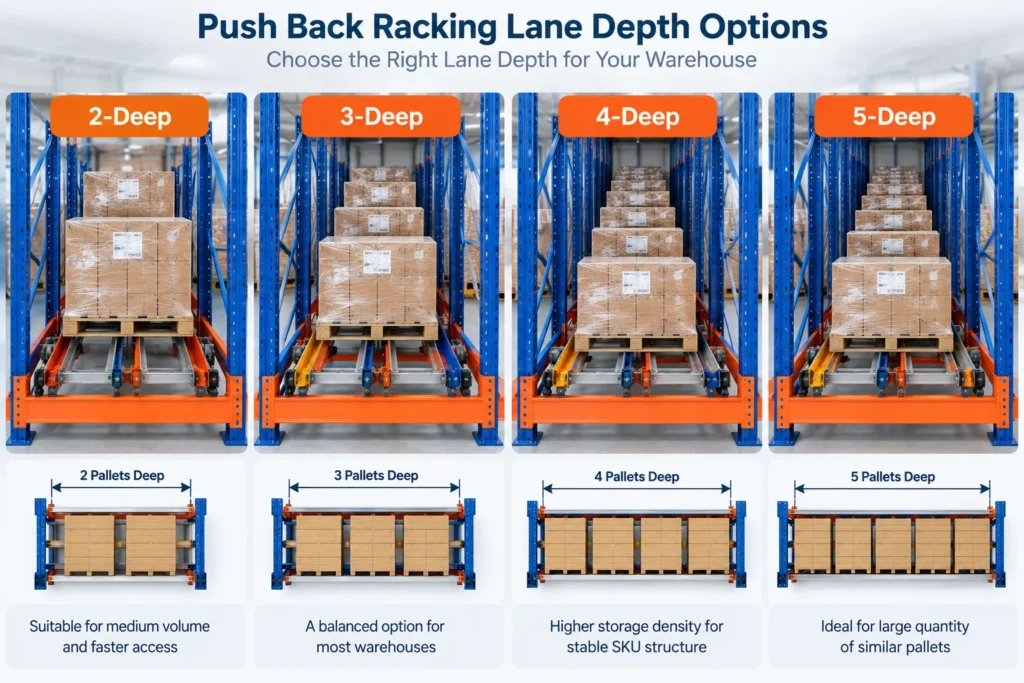
Lane depth means how many pallets are stored in one push back lane from front to back.
Common project discussions may include:
| Lane Depth | General Use Situation | Key Point to Check |
|---|---|---|
| 2-deep push back rack | Warehouses needing moderate density and easier access | Lower system complexity and easier operation |
| 3-deep push back racking | Warehouses with multiple pallets per SKU | Balance between density and access |
| 4-deep push back racking | Higher-density storage with stable SKU structure | Pallet quality and cart movement become more important |
| 5-deep push back racking | Bulkier lane storage for suitable LIFO applications | Operation control and lane planning need closer review |
| 6-deep or deeper discussions | Special project-based storage requirements | Requires careful review of pallet, load, forklift and layout conditions |
A deeper lane can increase storage density, but it does not always improve warehouse performance. If each SKU has only a small number of pallets, deep lanes may reduce accessibility and create inventory management problems.
For system comparison, see push back vs drive-in racking.
How to Choose the Right Push Back Rack Lane Depth
The right lane depth depends on the actual warehouse operation.
Choose Shallower Lanes When:
- SKU variety is higher
- Each SKU has fewer pallets
- Pallets are picked more frequently
- Faster access is more important than maximum density
- Pallet quality is not highly consistent
- Operators need easier handling control
Choose Deeper Lanes When:
- Each SKU has many pallets
- LIFO storage is acceptable
- Pallet size and weight are consistent
- Loads are stable
- The warehouse wants higher storage density
- Forklift operators are trained for lane-based storage
- The operation can manage lane-level inventory
Buyer Tip
Do not choose 5-deep or 6-deep push back racking only because it stores more pallets on paper. The better question is:
How many pallets per SKU can your warehouse store and retrieve without creating unnecessary handling problems?
Rack Height and Beam Level Spacing
Push back racking height should be planned together with loaded pallet height, forklift lifting height, beam spacing and clear height.
Important height factors include:
- Overall rack height
- Number of storage levels
- Loaded pallet height
- Vertical clearance above the pallet
- Beam level spacing
- Forklift lifting height
- Ceiling clear height
- Sprinkler clearance
- Lighting and building obstructions
A taller rack does not automatically create more usable pallet positions. If the forklift cannot safely reach the upper levels, or if sprinkler clearance is not enough, the theoretical rack height may not be practical.
For load-related planning, read our pallet rack weight capacity guide.
Cart and Rail Dimensions
The cart and rail system is the main difference between push back racking and standard pallet racking.
A push back rack may include:
- Nested carts
- Guide rails
- Pallet stops
- Load beams
- Upright frames
- Row spacers
- Bracing
- Base plates and anchors
- Rack protectors
Cart and rail dimensions should match:
- Pallet width
- Pallet depth
- Pallet bottom structure
- Pallet weight
- Lane depth
- Rack level height
- Operating temperature
- Required movement control
If the cart system is not matched to the pallet, the rack may still look correct in layout drawings but perform poorly in daily operation.
Aisle Width and Forklift Access
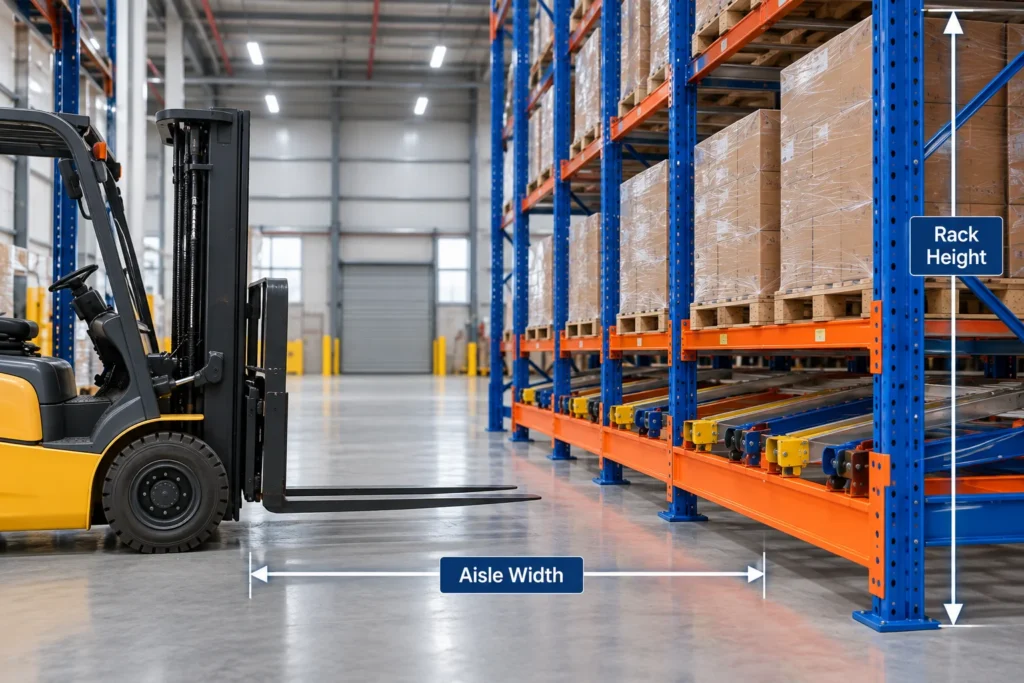
Push back racking is loaded and unloaded from the front aisle. This makes forklift access easier than drive-in racking in many applications, but aisle width still needs to be checked carefully.
Aisle width depends on:
- Forklift model
- Turning radius
- Load length
- Pallet depth
- Rack height
- Operator visibility
- Building columns
- Dock and door locations
- Traffic direction
- Safety clearance
Final aisle width should not be guessed from a general chart. It should be reviewed according to the actual forklift model and loaded pallet size.
If the warehouse uses reach trucks, counterbalance forklifts or other handling equipment, the rack layout should be adjusted accordingly.
Pallet Quality and Bottom Support
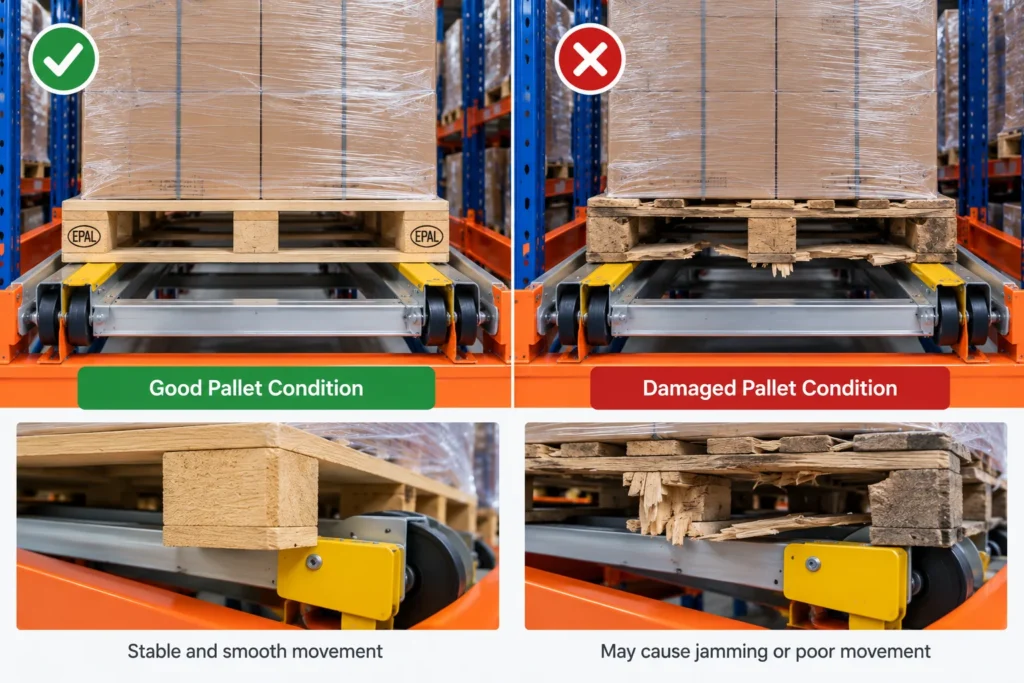
Pallet quality is especially important in push back racking because pallets move on carts or rails.
Buyers should check:
| Pallet Condition | Effect on Push Back Racking |
|---|---|
| Consistent pallet size | Supports smoother lane movement |
| Strong pallet bottom | Helps stable support on carts or rails |
| Damaged pallet boards | May increase risk of jamming or poor positioning |
| Irregular load shape | May affect stability during movement |
| Uneven load distribution | May create unsafe movement or support issues |
| Excessive overhang | May reduce clearance and increase impact risk |
| Mixed pallet types | May require separate lane planning |
Poor pallet condition does not always mean push back racking cannot be used, but it should be reviewed before finalizing the system.
Push Back Racking Dimensions vs Selective Racking Dimensions
Push back racking and selective racking may store the same pallet, but the dimension planning logic is different.
| Factor | Selective Pallet Racking | Push Back Racking |
|---|---|---|
| Pallet access | Direct access to each pallet | Lane-based front access |
| Main dimension focus | Beam opening, frame depth, aisle width | Lane depth, cart size, rail spacing and pallet support |
| Inventory flow | FIFO or flexible | Usually LIFO |
| Pallet movement | Static on beams | Moves on carts or rails |
| Pallet quality requirement | Important | More critical for movement |
| Storage density | Medium | Higher in suitable applications |
| Best for | High SKU variety | Multiple pallets per SKU |
For warehouses with many SKUs and direct pallet access requirements, selective pallet racking guide may be easier to manage.
Push Back Racking Dimensions vs Drive-In Racking Dimensions
Push back and drive-in racking are both high-density pallet storage options, but their layout dimensions are planned differently.
| Factor | Push Back Racking | Drive-In Racking |
|---|---|---|
| Forklift movement | Forklift stays in front aisle | Forklift enters rack lane |
| Lane structure | Carts and rails | Support rails and drive-in lanes |
| Main clearance concern | Pallet movement and front loading | Forklift entry clearance |
| Pallet access | Front aisle by lane | Inside lane access |
| Common inventory flow | LIFO | Usually LIFO |
| Impact risk | Mainly front aisle and rack face | Higher inside rack lanes |
| Best use | Density with easier front access | Bulk storage of similar pallets |
For bulk storage with forklifts entering the rack lane, view our drive-in pallet racking system page.
Load Capacity and Floor Capacity Should Be Reviewed Together
Push back racking dimensions and load capacity are connected.
Changing one of the following may affect the rack configuration:
- Pallet weight
- Lane depth
- Number of pallets per lane
- Beam span
- Upright height
- Beam level spacing
- Cart and rail structure
- Base plate position
- Anchor condition
- Floor slab capacity
Rack load capacity and warehouse floor capacity should not be treated as the same thing.
Rack capacity refers to the steel rack structure. Floor capacity refers to whether the concrete slab can support concentrated base plate reactions and anchoring requirements.
The final rack configuration should be confirmed through project-specific engineering calculations, load information, warehouse drawings, equipment parameters and applicable local requirements.
Fire Protection, Clear Height and Building Constraints
Warehouse building conditions may limit the final push back rack dimensions.
Before confirming the layout, check:
- Sprinkler clearance
- Roof beams
- Lighting
- HVAC equipment
- Wall clearance
- Fire exits
- Emergency access
- Column grid
- Dock doors
- Floor joints
- Drainage slopes
- Local safety requirements
A rack layout that fits on paper may still need adjustment after reviewing building restrictions and site conditions.
Common Mistakes When Planning Push Back Racking Dimension
1. Choosing Lane Depth Only by Storage Density
A deeper lane may add pallet positions, but it can reduce accessibility if SKU structure does not match the design.
2. Ignoring Pallet Bottom Condition
Push back carts and rails need stable pallet support. Damaged pallet bottoms may cause operation problems.
3. Using Empty Pallet Size Instead of Loaded Pallet Size
The loaded pallet may be wider, deeper or taller than the pallet itself because of product overhang.
4. Forgetting Forklift Turning Radius
A rack layout that does not match the forklift model can create difficult or unsafe operation.
5. Ignoring Sprinkler Clearance
Rack height should be checked together with fire protection requirements and available clear height.
6. Comparing Quotes Without Checking Lane Depth
A 2-deep system and a 5-deep system are not the same. Cart quantity, rail structure, steel configuration and installation complexity can be very different.
7. Treating Product Price as Total Project Cost
Push back racking cost may include carts, rails, pallet stops, protectors, row spacers, anchors, packaging, shipping and installation support. Always compare the full supply scope.
For more budgeting details, see pallet racking cost factors.
Information Needed for a Push Back Racking Layout
To prepare a suitable push back rack design, please provide the following information.
Warehouse Information
- Warehouse layout or CAD drawing
- Available length and width
- Clear height
- Column positions
- Door and dock locations
- Fire protection restrictions
- Floor information if available
- Operating temperature
- Destination port or delivery address
Pallet and Load Information
- Pallet width
- Pallet depth
- Loaded pallet height
- Maximum pallet weight
- Product overhang
- Pallet type
- Pallet condition
- Load stability
- Number of SKUs
- Pallets per SKU
- Required pallet positions
Forklift and Operation Information
- Forklift model
- Forklift lifting height
- Turning radius
- Required aisle width
- Daily inbound and outbound volume
- Picking frequency
- FIFO or LIFO requirement
- Future expansion plan
Project Scope
- Supply-only or installation support
- Required BOQ format
- Packaging requirement
- Shipping terms
- Local installation responsibility
- Required drawings or technical documents
This information helps determine whether push back racking is suitable, what lane depth is practical, and how the rack configuration should be quoted.
How DJ Storage Rack Supports Push Back Racking Projects
DJ Storage Rack supports push back pallet racking projects with layout review, custom rack configuration and project-based quotation.
We can help buyers review:
- Pallet size and load condition
- Suitable lane depth
- Rack height and beam level spacing
- Forklift aisle requirements
- Cart and rail configuration
- Storage density and usable capacity
- Packaging and delivery requirements
- BOQ quotation for overseas projects
Send your warehouse layout, pallet dimensions, maximum pallet weight, required pallet positions and forklift information for an initial push back racking layout review.
CTA:
Request a Push Back Racking Layout Review
Contact:
WhatsApp / Phone: +86 1935551 8784
Email: info@dj-rack.com
Conclusion
Push back racking dimensions should be planned from real warehouse data, not only from standard rack sizes. Pallet dimensions, lane depth, loaded height, cart and rail structure, forklift access, floor condition and inventory flow all affect the final layout.
A deeper push back rack lane can increase storage density in suitable LIFO applications, but it should match SKU quantity, pallet quality and daily operation. For many buyers, the best solution is not the deepest lane, but the lane depth that provides enough storage while keeping pallet handling practical and safe.
For project quotation, prepare your warehouse layout, pallet size, pallet weight, forklift model and required pallet positions before comparing suppliers.
FAQ
What are the main dimensions of push back racking?
The main dimensions include pallet width, pallet depth, loaded pallet height, rack height, beam level spacing, lane depth, cart size, rail spacing, aisle width and forklift clearance.
How deep can push back racking be?
Push back racking is commonly discussed in 2-deep, 3-deep, 4-deep, 5-deep or deeper lane configurations. The final depth depends on pallet size, pallet weight, SKU quantity, pallet stability, forklift operation and warehouse layout.
Is a deeper push back rack always better?
No. A deeper lane can increase storage density, but it may reduce accessibility and complicate inventory control if SKU quantity, pallet quality or daily operation does not match the layout.
What pallet information is needed for push back racking design?
Buyers should provide pallet width, pallet depth, loaded pallet height, maximum pallet weight, pallet type, pallet condition, product overhang and load stability.
Does forklift type affect push back racking dimensions?
Yes. Forklift model, turning radius, lifting height, load depth and operator visibility can affect aisle width, rack layout and loading clearance.
Is push back racking suitable for FIFO storage?
Push back racking is normally used for LIFO storage. If strict FIFO inventory rotation is required, pallet flow racking may be a better option.
What affects push back racking cost?
Cost is affected by rack height, lane depth, pallet weight, cart and rail structure, steel configuration, safety accessories, floor condition, packaging, freight terms and installation scope.
What information is needed for a push back racking quotation?
You should provide warehouse layout, clear height, pallet dimensions, maximum pallet weight, loaded pallet height, number of SKUs, pallets per SKU, required pallet positions, forklift model, inventory flow and destination port.